

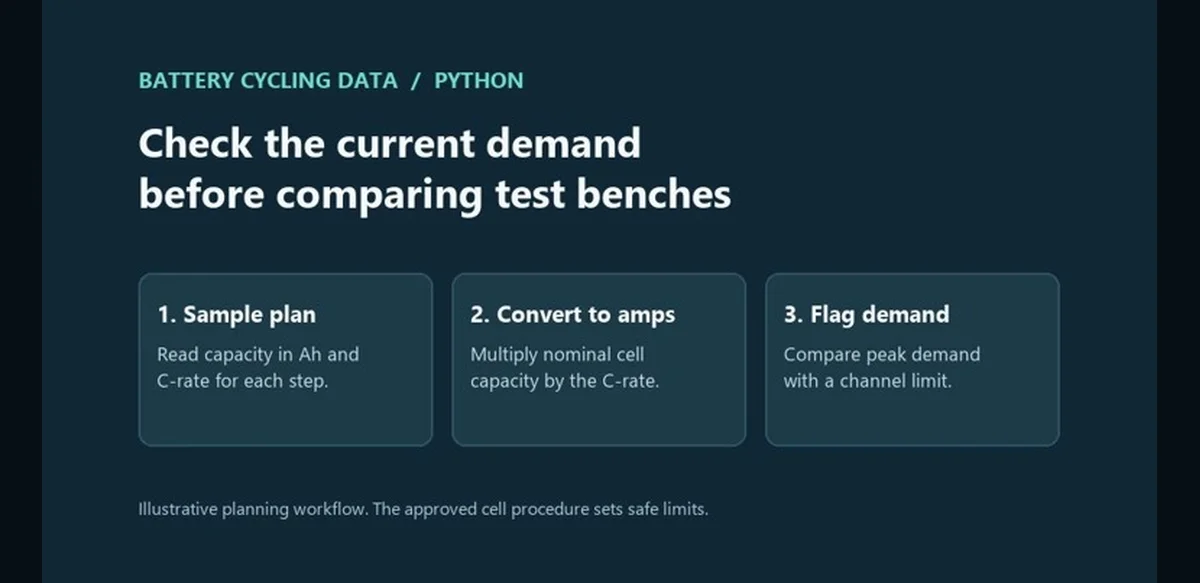
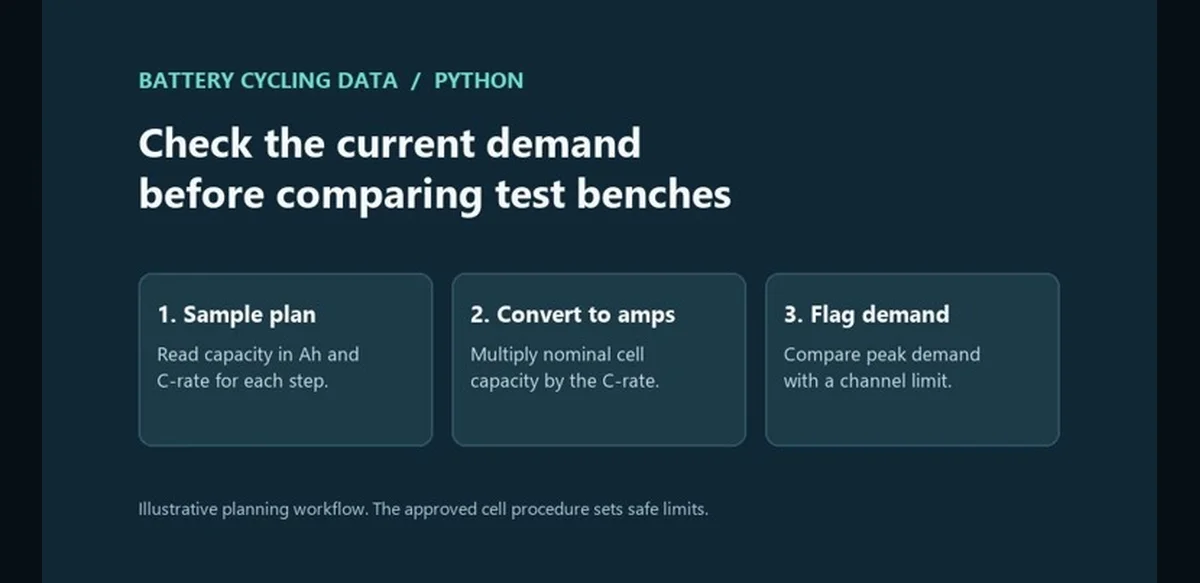
Engineers working with long-duration battery evaluations often encounter challenges when standard equipment settings fail to match the demands of extended test sequences. A typical cell examination may align with the cycler during initial phases yet surpass the preset current limits as the process continues. This mismatch can interrupt data collection and affect the reliability of results.
To address such issues, specialists have turned to programming solutions that calculate appropriate current values based on standard battery metrics. One common approach involves converting a battery’s C-rate specification into actual amperage figures suitable for the testing hardware. This conversion ensures that the equipment operates within safe and accurate parameters throughout the entire cycle.
The process begins with understanding the relationship between a cell’s capacity and the desired charge or discharge rate. Capacity is usually measured in ampere-hours, while the C-rate indicates how quickly that capacity is utilized. For instance, a one C-rate corresponds to a current equal to the cell’s full capacity delivered over one hour. Higher or lower rates require proportional adjustments.
Python scripts provide a flexible way to perform these calculations repeatedly and with precision. Developers can write functions that accept capacity and C-rate as inputs and return the corresponding current value. Such tools integrate easily into pre-test planning workflows, allowing teams to verify settings before initiating any physical experiments.
In practice, these scripts help prevent errors that arise from manual computations. They also support documentation of test parameters, which is essential for reproducibility in research environments. By automating the conversion step, engineers reduce the risk of exceeding equipment capabilities during prolonged operations.
Battery testing plays a vital role in fields ranging from energy storage development to quality assurance for electronic devices. Accurate current control contributes to consistent data on cell performance, degradation patterns, and safety margins. When tests run without interruption, researchers obtain clearer insights into how different conditions affect battery behavior over time.
The use of open-source programming languages like Python lowers barriers for teams seeking custom solutions. Libraries for numerical operations and data handling make it straightforward to build reliable conversion utilities. These utilities can be shared across projects or adapted for specific hardware configurations.
Overall, incorporating computational planning into battery evaluation routines enhances both efficiency and precision. As testing protocols grow more complex, such methods offer a practical means to maintain control over experimental variables. Continued refinement of these tools supports broader advancements in energy technology assessment.





Comment
0Upholding journalistic discourse. No registration required.
No comments yet. Share your perspective!