

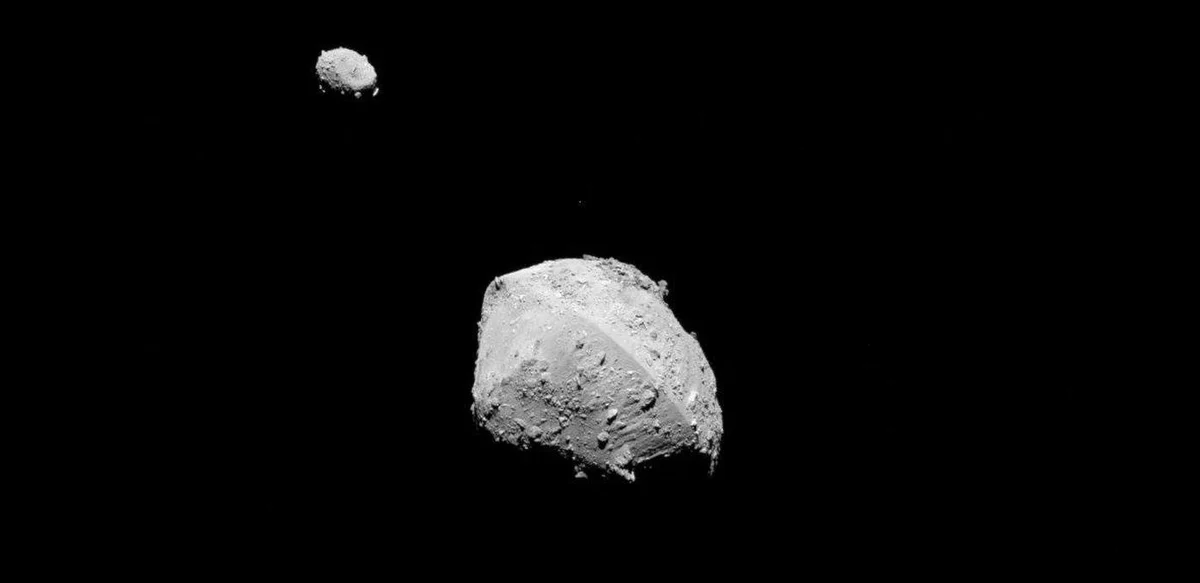
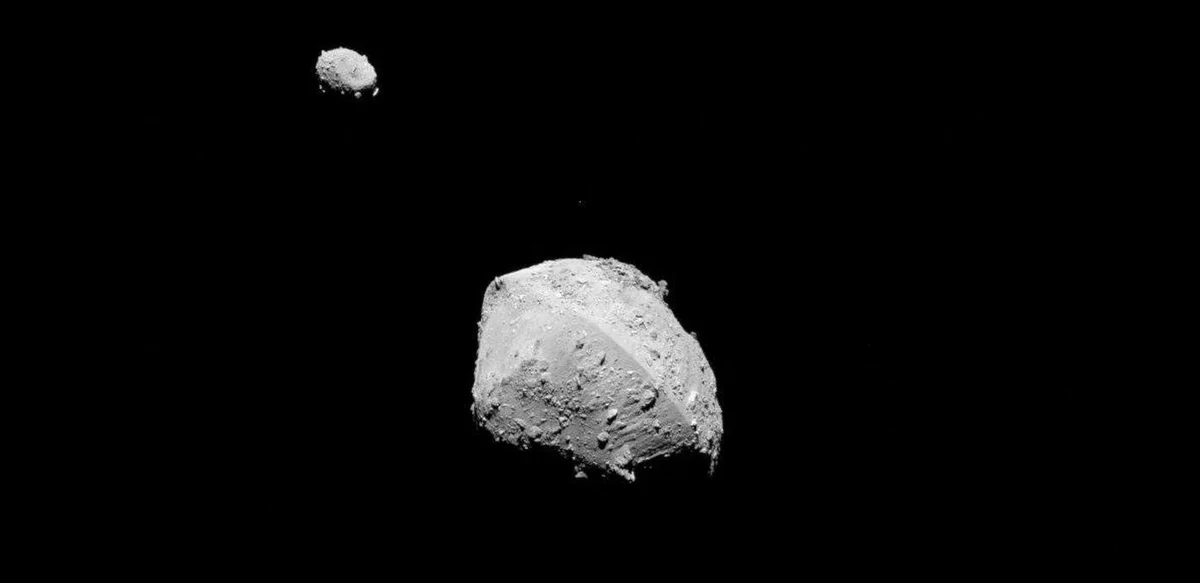
Recent photographs have provided fresh details about the aftermath of a spacecraft collision with a small asteroid. The event took place on September 26, 2022, when the Double Asteroid Redirection Test vehicle made contact with the asteroid known as Dimorphos. The images show a distinct crater formed at the point of impact.
The asteroid continues to rotate irregularly following the encounter. Observations indicate that numerous boulders have been dislodged and are moving in the vicinity of the main body. These details come from analysis of data collected after the test.
The mission was designed to examine how a spacecraft impact could alter the path of a near-Earth object. By striking Dimorphos, researchers aimed to measure any resulting change in its orbit around its companion asteroid. The new visuals help confirm the physical effects of that strike.
Scientists have noted the presence of ejected material around the asteroid. This material appears as scattered rocks of varying sizes. The tumbling motion of the asteroid has also been documented through repeated imaging sessions.
Further study of the crater and surrounding debris is expected to yield additional information about the asteroid’s composition and structure. Such data supports ongoing efforts to understand how similar objects might respond to deflection attempts.
The test represents one step in broader research into methods for protecting Earth from potential asteroid threats. Continued monitoring of Dimorphos will allow comparison of its current state with pre-impact conditions.
Images released to date have been processed to highlight surface features. They reveal both the newly formed depression and the distribution of loose material. Analysts continue to review the full set of observations for additional patterns.
The irregular rotation observed after the collision suggests that the impact transferred significant momentum to the asteroid. This outcome aligns with expectations for a kinetic impactor approach. Boulders seen in the images provide clues about surface stability.
Overall, the mission has supplied valuable information on asteroid behavior under controlled impact conditions. Future missions may build on these findings to refine deflection techniques.
Public release of the images has allowed wider examination by the scientific community. Discussions focus on the crater’s characteristics and the asteroid’s altered dynamics. No immediate changes to orbital predictions have been reported beyond those already modeled.
The event underscores the importance of precise timing and targeting in such experiments. Data gathered will inform planning for any subsequent tests involving similar objects.
In summary, the photographs offer a clearer view of the results from the 2022 collision. They document the crater, the tumbling motion, and the flying boulders without introducing new variables into the established record of the test.





Comment
0Upholding journalistic discourse. No registration required.
No comments yet. Share your perspective!