

On 5 May 2017, barely months after the BJP came to power in Uttar Pradesh and Yogi Adityanath assumed the chief minister’s office for his first term, caste violence erupted in Shabbirpur village of Saharanpur, the state’s northernmost district at the foothills of the lower Himalaya. More than 50 Dalit homes were torched when a procession of upper caste Rajputs, ‘celebrating’ Maharana Pratap Jayanti, vandalised a statue of Sant Ravidas, revered by the state’s Dalits.
The violence brought two young Dalit activists, Ravi Gautam and Chandrashekhar, together. Gautam was with the Yuva Shakti Dal, a Bahujan socio-political outfit. Azad then headed the Bhim Army he’d set up in 2015. {The Azad Samaj Party (Kanshi Ram) he now heads was floated in 2020)} Both hail from the Jatav/Chamar community. They mobilised protests and called a maha panchayat at Saharanpur city’s Gandhi Maidan on 9 May. Their agitation culminated in a major protest at Delhi’s Jantar Mantar on 21 May.
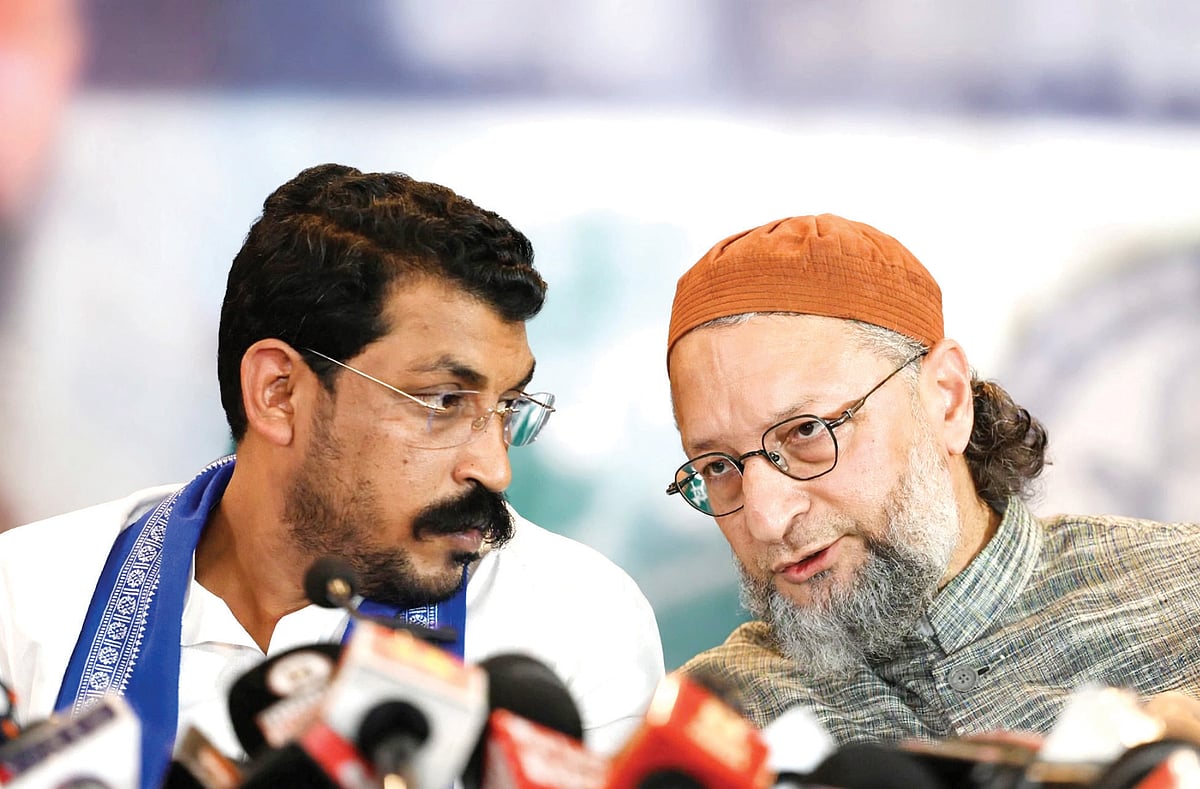
Their political paths have since diverged. Ravi has joined the Samajwadi Party (SP) while Chandrashekhar leads the Azad Samaj Party, which recently entered an alliance with Asaduddin Owaisi’s AIMIM (All India Majlis-e-Ittehadul Muslimeen) to challenge Akhilesh Yadav in the upcoming state Assembly election.
Dalits make up over 20 per cent of the state and the Samajwadi Party (SP) is making a big push to win their support, moving beyond its traditional Muslim-Yadav base to capitalise on the electoral decline of the Bahujan Samaj Party (BSP).
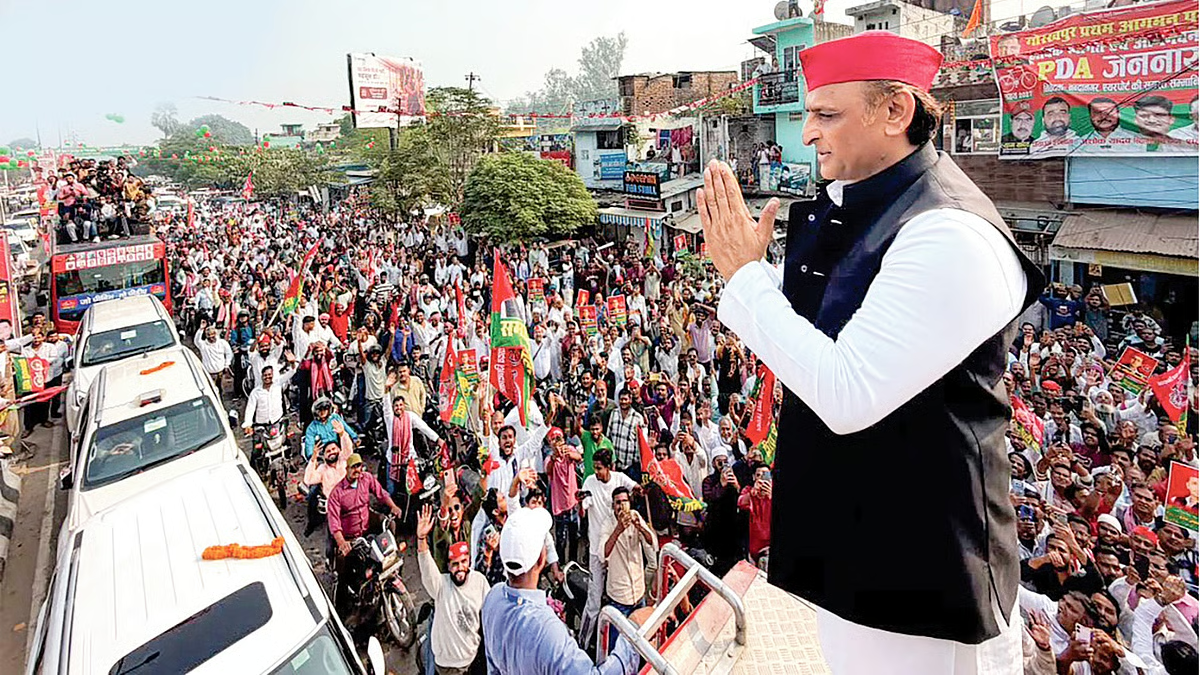
On 15 November, a massive crowd gathered in Agra for the SP’s first major Dalit convention in nearly two decades. Manoj Kumar, a resident of Hapur active with the SP for over 20 years, believes the party outreach is gaining traction. “Dalits have received more respect in the SP in the past two years than ever before. The Jatav community is losing faith in Mayawati. People feel that Behenji cannot stand with them on their issues. Only if the right to vote survives will the Constitution survive, and so also people’s access to rations and government schemes,” he says.
Ravi is less dismissive of Mayawati’s legacy. “When she was in power, she did a great deal for the community. But she failed to give young people a greater stake in the party. Akhilesh Yadav raises Dalit issues, provides financial assistance and stands with people in their fight. That is why they are gravitating towards him,” he says.
Addressing the Agra gathering, Akhilesh linked the battle for Dalit support to the protection of constitutional rights: “Those who want to destroy the Constitution also want to take away your vote. If your vote is lost, the Constitution will not survive.” This was an echo of the SP-Congress campaign in the 2024 Lok Sabha elections, when saving the Constitution became the central plank of the Opposition.
While the BJP spoke of ‘400-paar’, a mandate of 400-plus seats, fuelling concerns that they would overturn constitutional protections and guarantees that give the country’s backward communities something to hold on to, Rahul Gandhi had already undertaken the Bharat Jodo Yatra and the Bharat Jodo Nyay Yatra.
The Congress organised Samvidhan Samman Sammelans across major cities while the SP pushed its PDA (Pichhda–Dalit–Alpasankhyak) formula. Where most of the political commentariat was giving the BJP a clean sweep, the INDIA alliance won 43 of the state’s 80 Lok Sabha seats.
The SP also tested old caste equations by fielding Dalit candidates from general constituencies. In Ayodhya, Awadhesh Prasad of the Pasi community defeated the BJP, puncturing its triumphalist narrative around the Ram Mandir inauguration just a few months prior.
Awadhesh Prasad has since become the face of Akhilesh’s PDA pitch. A big draw at the Agra convention, he sits next to Akhilesh in Parliament’s front row — as if to simply rub it in that after all the BJP-RSS theatre around the inauguration of the Ram Mandir, the BJP still lost Ayodhya.
****
Uttar Pradesh has 86 reserved Assembly seats. In 2022, the BJP-led NDA won 65, while the SP alliance secured 20. In 2024, with some help from the Congress, the SP won seven of the state’s 17 reserved Lok Sabha seats and the Congress one, while the NDA got eight. Those results indicate a strong SP-Congress presence among Dalit voters.
At the Agra convention, when Akhilesh said “The D in PDA stands for ‘Damdaar Dalit’,” he meant an assertive generation — activists like Ravi, prepared to take to the streets for their dignity and rights. More than 200 statues of Babasaheb Ambedkar had been vandalised in Uttar Pradesh, he said, calling the attacks an assault on the hand that wrote the Constitution.
Rajya Sabha MP Ramjilal Suman, a Jatav and five-time MP and a longtime associate of Mulayam Singh Yadav, who coordinated the convention, said the vandalisation was proof that the BJP-RSS was out to undermine Ambedkar’s legacy and to show Dalits their place in society.
Before 2019, Mayawati would always invoke the infamous 1995 guesthouse incident (when she and her party MLAs were gheraoed and attacked amid the collapse of the SP-BSP coalition government) to make the point that the Samajwadi Party was pathologically anti-Dalit. But the post-2024 Lok Sabha landscape appears different — the SP is now preparing to hold conventions like the one in Agra across all 18 administrative divisions (mandals), which together encompass the state’s 75 districts.
****
Dalits constitute approximately 20 per cent of the population of Uttar Pradesh. For decades, the BSP was their principal political vehicle and its decline has triggered an intense contest for their support among the BJP, SP, Congress and newer political formations.
The electoral shift is striking. In 2007, the BSP won 62 of the state’s 86 reserved Assembly seats and formed a majority government. The SP won 58 in 2012. The BJP subsequently consolidated non-Yadav OBCs and non-Jatav Dalits, weakening both parties. It won all 17 reserved Lok Sabha seats in 2014 and 15 in 2019, despite the SP-BSP alliance. In the 2017 Assembly elections, the BJP-led NDA captured 70 reserved seats and in 2022, it won 65. The BSP, meanwhile, plummeted from 19 Assembly seats in 2017 to just one in 2022. The party’s declining vote share mirrors the same reality: from 30.4 per cent in 2007 to 22.2 per cent in 2017 and 12.9 per cent in 2022.
Since late October, Mayawati’s nephew Akash Anand, apparently back in her good books, has addressed rallies in Bulandshahr, Saharanpur, Bareilly and Bijnor, seeking to revive the BSP. Imran Malik, a BSP supporter and hardware trader from Shikarpur who attended the Bulandshahr rally, says the gathering attracted people across communities, including Brahmins and Muslims. Prof. Vikram Harijan of Allahabad University thinks the BSP might do better this time.
Meanwhile, Chandrashekhar and Owaisi have formed the Samajik Parivartan Morcha (SPM) and say they will contest all 403 Assembly seats. They have chosen to direct their attack on Akhilesh rather than the incumbent BJP, but that is hardly surprising, given Owaisi’s track. The two parties together secured less than one per cent of the vote in 2022, but Chandrashekhar’s Azad Samaj Party got 14.6 per cent in the four Lok Sabha constituencies it contested in 2024, signalling growing support and a potential challenge to both the SP–Congress alliance and the BSP.
Prof. Sheeshpal Gautam of Pt Sunderlal Memorial College, Kannauj, believes Chandrashekhar has channelled Dalit anger into street mobilisation, but advocate Netrapal Singh of Kithore offers a different assessment: Chandrashekhar may dent the Opposition alliance somewhat, but voters understand that only the SP-Congress combine can defeat the BJP and are unlikely to split their vote.
On 26 November, Akhilesh is scheduled to present the party’s manifesto. At Agra, he offered a preview: a separate budget for SC/STs, minimum wages and overtime provisions for workers, including those in Agra’s footwear factories and legal safeguards against the vandalisation of statues. Party workers have been asked to take notes on the demands and concerns of Dalits in their constituencies.
The battle for the Dalit vote is not limited to the reserved constituencies. It is about who can credibly represent their aspirations — offering dignity, political agency, economic opportunity and a meaningful stake in governance.



Comment
0Upholding journalistic discourse. No registration required.
No comments yet. Share your perspective!