

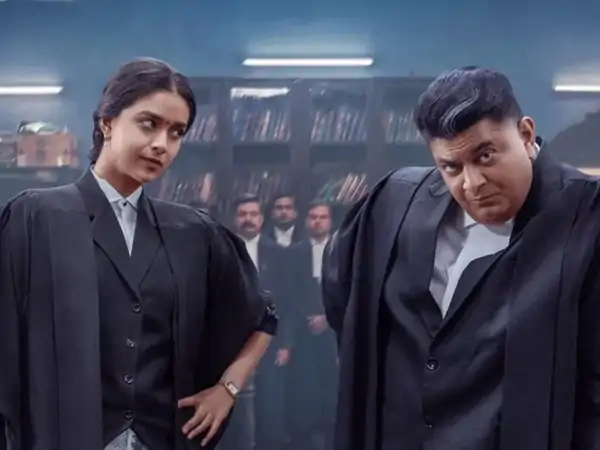

There is something inherently appealing about watching an underdog take on an established authority, particularly when the contest involves a battle of wits. Sathyavan Savithiri builds its central conflict around this familiar dynamic, placing a relatively inexperienced lawyer against a formidable opponent who has made a career out of staying one step ahead of everyone else.
However, director Praveen S Vijaay is less interested in reinventing the courtroom drama than in using its conventions to tell a story about personal agency, justice and the choices people make when pushed into a corner. The result is a film that has its share of narrative conveniences and predictable turns, but finds considerable strength in the performances of its two leads.
Keerthy Suresh plays Savithiri, a young woman with ambitions of becoming a successful lawyer. Her personal life, however, takes a rather different course when she finds herself married to Deepak (Charukesh). What initially appears to be a conventional domestic setup gradually gives way to a legal conflict when Deepak becomes embroiled in a murder case. Savithiri's professional and personal lives eventually collide, placing her in a position where she must defend her husband while taking on Markandeyan (Mysskin), a senior advocate whose reputation precedes him. The film draws from the familiar mythological story of Sathyavan and Savithiri, adapting its central idea of a woman challenging seemingly insurmountable odds to a contemporary legal setting.
One of the more interesting aspects of the film is how it establishes the ideological differences between its central characters. Markandeyan approaches his profession with a rather uncompromising understanding of what it means to win a case, while Savithiri's outlook is shaped by a more personal understanding of justice. Their initial professional association gives way to an adversarial relationship, with the subsequent legal battle carrying considerably higher stakes. The dynamic is familiar, but the contrast between the two personalities gives the proceedings an engaging quality, especially when the film allows its leads to go head-to-head.
Keerthy Suresh is the film's emotional anchor. Savithiri is a character who undergoes a considerable transformation, and Keerthy makes that journey convincing without relying entirely on dramatic gestures. There is an endearing quality to her portrayal in the earlier portions, particularly in the way she navigates situations that are beyond her immediate control. As the circumstances become increasingly complicated, the performance acquires a different intensity. What makes her work particularly effective is the ability to retain the character's vulnerability even as she grows more assertive. Savithiri's eventual resolve never feels entirely detached from the person we are introduced to at the beginning. This becomes especially important in the final act, where the film places considerable emotional weight on her character.
Mysskin, meanwhile, is an absolute delight to watch. As Markandeyan, he brings an almost theatrical quality to the proceedings, making the character's eccentricities and excesses an integral part of his appeal. His mannerisms, delivery and peculiar approach to courtroom arguments could easily have become distracting in the hands of a less assured performer. Instead, Mysskin understands precisely how much to lean into the character's flamboyance. There is an unpredictability to his screen presence that keeps even the more familiar confrontations interesting. More importantly, he makes for an effective foil to Keerthy, with their contrasting approaches providing some of the film's most entertaining exchanges. It is a performance that understands the pleasure of being larger than life without losing sight of the character.
Where Sathyavan Savithiri is less convincing is in the construction of its narrative. The film takes some time to settle into its central conflict, and the personal portions preceding the legal proceedings do not always receive the development they require. The transition from Savithiri's domestic circumstances to her professional confrontation with Markandeyan could have been handled with greater finesse. There are also stretches where the writing seems more concerned with getting the characters to the next significant development than allowing the situations to unfold organically. Consequently, certain emotional beats do not land with the intended force.
The courtroom portions are entertaining in their own way, although viewers looking for a particularly rigorous legal drama might find the proceedings somewhat theatrical. The arguments and revelations are frequently designed for dramatic impact rather than procedural credibility. This approach is not necessarily a problem, but the film occasionally relies on convenient developments to move the story forward. Its investigative elements, too, could have benefited from a more carefully structured screenplay. There is an interesting conflict at the heart of the story, but the writing does not always explore its implications as thoroughly as it could have.
The final act, however, brings the various strands together with a degree of conviction. While the eventual revelation is not particularly difficult to anticipate, the predictability does not diminish the impact of its execution. The film lays the groundwork for its concluding developments through a series of narrative cues, and the payoff works because the emotional investment is already in place. Much of the credit belongs to Keerthy, whose handling of Savithiri gives the concluding stretch its required weight. Rather than depending solely on the surprise of the revelation, the film finds its impact in how the character responds to what unfolds. It is a distinction that makes the climax considerably more satisfying than the screenplay's occasional shortcomings might suggest.
The supporting cast, particularly Bala Saravanan, adds some welcome lighter moments, although not every character receives enough attention to leave a lasting impression. Sam CS's background score contributes to the dramatic atmosphere, even if its tendency to underline certain moments can occasionally feel excessive. The technical aspects are largely functional, serving the narrative without making a particularly distinctive impression.
Praveen S Vijaay's film has an interesting premise and two performers who understand exactly what the material demands of them. It could have been a more cohesive courtroom drama with tighter writing, better-developed relationships and greater attention to the intricacies of its central conflict. Nevertheless, Sathyavan Savithiri remains an engaging watch, particularly when Keerthy Suresh and Mysskin share the screen. Its final act might not surprise everyone, but it delivers the emotional payoff it sets out to achieve. And sometimes, how a story reaches its destination matters just as much as where it takes you.
ALSO READ: Exclusive: Keerthy Suresh on Why She Earlier Did Small Roles in Big Ticket South Films




Comment
0Upholding journalistic discourse. No registration required.
No comments yet. Share your perspective!