

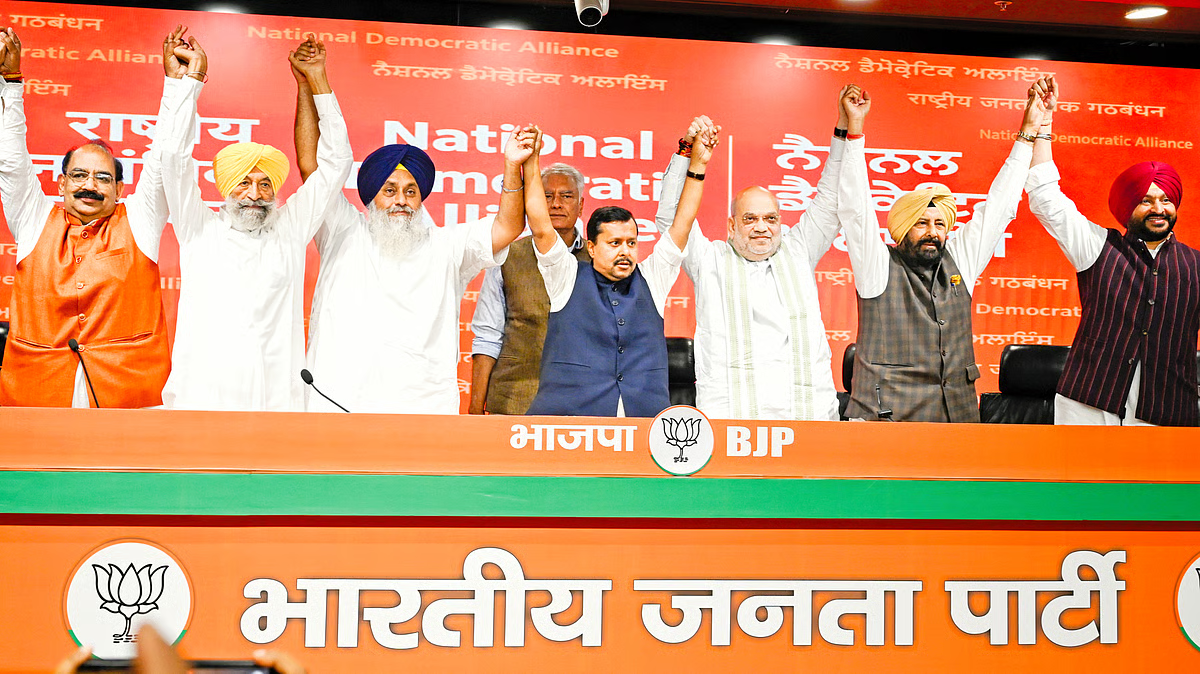
In rural Punjab they say a quarrel between relatives lasts only until the next viah (wedding) in the family. This Gurpurab, six years after Harsimrat Kaur Badal walked out of the Modi cabinet over the farm laws, Amit Shah and Sukhbir Badal joined hands at the BJP headquarters in New Delhi, signalling the Akali Dal’s return to the NDA.
It is also said that in Punjab politics, the photo album is always kinder than memory. Sharing the frame with Shah and Badal was Ravneet Bittu, who not long back had said the BJP could not carry the Akali burden of drugs and sacrilege.
The surprise was Shah’s generosity. The Akalis, he said, would remain the bada bhai. He said the farm laws, over which Akalis had walked out of the NDA, no longer mattered since they were repealed. Sukhbir called it “not merely a political alliance, but an emotional one”, invoked his father’s bond with Vajpayee and Advani, and announced that Prime Minister Narendra Modi would come to Moga on 8 December for Parkash Singh Badal’s birth anniversary. Both sides spoke of Hindu–Sikh brotherhood, drugs and jobs. It was the old Punjab, Punjabi, Punjabiyat script of 1996, dusted off for a new season.
But read the fine print. No seat-sharing formula was announced. Those privy to the talks say the BJP wants 46 or 47 seats, double the 23 it fought in the Badal years, leaving the Akalis with a little over 60. In 1997, the BJP was content to be a baraati: a good seat, plenty of pakoras, no say in the menu. This time it is in the kitchen helping to cook. It will be an uphill journey though with the Akalis having won three seats and the BJP just two in the 117-member Assembly in 2022.
On paper, the numbers add up — about 18.6 and 13.4 per cent vote share in 2024, nearly 32 per cent together, ahead of both the Congress and AAP.
Arithmetic, however, is not chemistry. Shah may call the farm laws irrelevant, but memories run long in the villages of Malwa. BJP old-timers fear being sidelined twice over, by the Akalis and by the turncoats queuing for tickets. The alliance, however, will come as a relief to the SAD, which is facing an existential crisis, and the BJP which was not making much headway in the state. The contest for 2027 now promises to be triangular between the ruling AAP, Congress and SAD-BJP alliance.
****
For three hours this past week, a quiet village in Baba Bakala tehsil became the centre of Punjab politics. Amritpal Singh, the jailed Khadoor Sahib MP, was flown in from Dibrugarh on custody parole for the cremation of his grandmother Mata Charan Kaur. It was his first time in Punjab in three-and-a-half years. He embraced his family, rode a tractor-trolley to the cremation ground and was whisked back to Amritsar airport in a bulletproof vehicle. National television covered every frame, as if a star had flown in for a cameo.
On the ground, the picture was more modest. Gurshamshir Singh, a journalist who was there, put the gathering at around 5,000. The three-acre pandal stayed half empty. Most came in buses, mobilised by local units; the individual admirers who once thronged his Khalsa Vaheer were few. There was little of the spontaneity of a sangat that feels wronged. Nor were there Khalistan slogans. Organisers asked the crowd to keep quiet, and they duly obeyed.
The firebrand who stormed the Ajnala police station in 2023 now leads a party of rule-of-law followers, mourning behind iron grills painted in the tricolour.
Three lessons follow. First, organisation. A party that has named its leader as its chief ministerial face could fill only half a pandal in his own village, on the most emotional occasion imaginable. The Panthic vote is less a fortress than a busy railway platform: crowded when a big train pulls in, empty soon after. Second, the gap between screen and sath. The Amritpal factor is real but concentrated in rural Majha and western Malwa, among young Jatt Sikh men and mothers who see him as the man who fought chitta. Beyond that belt the glass ceiling holds.
Third, the new alignment. With Amit Shah declaring the farm laws “no longer relevant”, Waris Punjab De becomes the natural address for Panthic voters who cannot stomach a Badal–BJP jaffi (embrace). Sukhbir knows it, which is why he calls the party a ‘virus’ that splits the Sikh vote.
The BJP, for its part, finds every prime-time image of a radical preacher useful for con-solidating Hindu votes in the towns, and Delhi’s prime time anchors will supply the drama the crowd did not.
The hawa is there, the jathebandi is not. Until Waris Punjab De builds one, its leader’s visits will make headlines in Delhi while the pandal in Punjab stays half-full.
After four years of kursi politics, the Congress has rediscovered sadak politics. As part of ‘Punjab Mangda Insaaf’, launched after Rahul Gandhi’s ‘Insaaf Rally’ at Sangrur on 4 November, Charanjit Singh Channi began his ‘Jawani Sambhal’ cycle yatra from Chamkaur Sahib to Khanna, roughly 625 km across 27 constituencies in eight days. PPCC chief Pargat Singh boarded a bus. Raja Warring, not to be left behind, has announced an ‘Insaaf march’.
Three vehicles, three messages. Channi’s cycle is a show of mass base. It is a clever symbol too: humble, sweaty and gritty, quietly stealing AAP’s own iconography of the aam aadmi, and an echo of the 2016 cycle yatra that first made him a statewide face.
Pargat’s bus, carrying the rank and file and an anti-AAP chargesheet through Majha and Doaba, is an assertion of authority. Barely seven weeks after replacing Warring, the Olympian must prove he is captain of the team and not merely its full-back. Warring’s march, starting near Ludhiana’s Clock Tower, is pitched at the towns.
The response tells its own story. In Samrala, Khanna, Ludhiana, Kotkapura and Faridkot the cycle drew genuine enthusiasm. In the villages it was muted. Warring stayed away when Channi passed through Ludhiana, then turned up at Beeja on the final day to cycle 14 km beside him. A perfect Bollywood climax.
Harjeshwar Pal Singh teaches history at SGGS College, Chandigarh. He is also an honorary director of the political consultancy, Punjab Thinks. More of his writing here

Comment
0Upholding journalistic discourse. No registration required.
No comments yet. Share your perspective!