

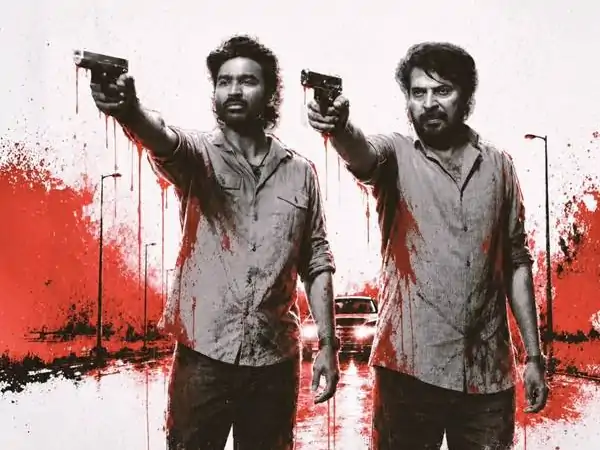

An undercover operative infiltrating a criminal organisation is a premise that cinema has explored in several different ways. What makes Rajkumar Periasamy's O.M: Operation Mole interesting, however, is its attempt to examine the personal consequences of such an assignment against the backdrop of the illegal red sandalwood trade. With Dhanush, Mammootty and Sai Pallavi at the centre of the narrative, the film has the ingredients for an engrossing crime thriller. There is an ambitious story here, one that attempts to balance an elaborate investigation with questions of loyalty, friendship and sacrifice. While the filmmaker gets several things right, particularly in his handling of the action and the principal characters, the film's considerable length and occasional narrative detours prevent it from becoming the gripping thriller it could have been.
Dhanush plays Palani, also known as Thiru, an undercover operative recruited by Nithya Reddy (Sai Pallavi), the head of a Special Task Force investigating an extensive red sandalwood smuggling network. The operation involves infiltrating the syndicate led by Burma Karthikeyan, also known as Siya (Mammootty), to reach its mastermind, Abdul Hameed (Naseeruddin Shah). Going undercover as Thiru, Palani gradually earns his place within the network. But as the operation progresses, the boundaries between his assumed identity and his personal life become increasingly difficult to negotiate.
The premise brings to mind Mike Newell's Donnie Brasco, another undercover crime drama built around an operative whose growing involvement with the people he is investigating complicates his professional responsibilities. While O.M operates within a distinctly different criminal landscape, it explores a similar tension between duty and the personal connections that develop during an undercover assignment. The comparison also highlights the emotional possibilities of the premise. The closer an operative gets to the people he is supposed to bring down, the more complicated the mission becomes. Rajkumar is clearly interested in exploring this conflict, although his screenplay does not always give these developments the space they deserve.
One of the film's strengths is the scale of the world it attempts to establish. The red sandalwood trade is not merely a backdrop for the action; it is central to the investigation and the conflicts that emerge from it. The first half takes considerable time to introduce the network, its players and the circumstances surrounding the operation. While this gives the story a detailed foundation, the exposition occasionally becomes cumbersome. Dhanush's single-shot introduction is a particularly impressive piece of staging, while the emotionally charged interval block gives the narrative a significant dramatic turn. It is here that the film begins to reveal the more personal story beneath the investigation.
Dhanush is the film's biggest asset. The actor brings considerable intensity to Palani, a character who must constantly negotiate between his assumed identity and the person he actually is. His physical commitment is evident in the action sequences, but the performance becomes more interesting when the film explores the psychological complications of the assignment. Dhanush finds room for vulnerability beneath the character's outward resolve, making Palani's emotional journey an important part of the narrative.
Mammootty brings an effortless authority to Burma Karthikeyan. The character is not treated as a straightforward antagonist, and the actor makes the most of this ambiguity. His restrained approach gives Siya a commanding presence without relying on exaggerated displays of power. The Dhanush-Mammootty combination is one of the film's biggest attractions, even if the screenplay could have explored their contrasting positions with greater dramatic depth. Sai Pallavi brings conviction to Nithya Reddy, giving the investigation a distinct perspective beyond that of the undercover operative.
Sreeleela plays Roja, Palani's wife, while Indrans plays his father. Both characters connect the operation to the protagonist's personal life, although the screenplay could have given these relationships greater depth. Renu Desai is also part of the supporting ensemble. Naseeruddin Shah's Abdul Hameed, despite his significance to the larger operation, has limited scope to make a lasting impression.
The narrative finds greater purpose after the interval, when the investigation begins to intersect more meaningfully with the characters' individual conflicts. The second half has a stronger emotional foundation, allowing the film to move beyond the procedural details of the operation. However, Rajkumar's tendency to play certain ideas safe prevents the story from fully exploring some of its more compelling concerns, particularly the exploitation of tribal communities and the larger machinery that sustains the illegal trade. These subjects give the film an opportunity to move beyond the familiar undercover thriller, but the screenplay does not pursue them with the necessary conviction. The different strands eventually converge towards the climax, though a more focused approach could have made the emotional and political dimensions considerably more effective.
On the technical front, Sai Abhyankkar's music adds energy to the film, particularly through its background score. K. Ezhil Arasu's cinematography captures the forest setting and gives the operation an appropriate sense of scale. The action choreography by Yannick Ben and Kecha Khamphakdee is another strength, while R. Kalaivanan's editing could have been tighter in the exposition-heavy portions.
O.M: Operation Mole is ultimately a film whose ambitions are more impressive than its execution. Rajkumar Periasamy demonstrates confidence in staging action and building a story around characters with conflicting motivations. Dhanush anchors the narrative with a committed performance, while Mammootty and Sai Pallavi give the central conflict considerable weight.
The film becomes more engaging when it moves beyond the mechanics of the investigation and explores the emotional consequences of the operation. Its lengthy exposition and reluctance to push some of its larger ideas further keep it from becoming the gripping crime thriller it sets out to be. Nevertheless, there is enough conviction in its performances, filmmaking and central conflict to make it a worthwhile watch.
ALSO READ: Mammootty, Adoor Gopalakrishnan’s Padayaatra Locks Theatrical Release



Comment
0Upholding journalistic discourse. No registration required.
No comments yet. Share your perspective!