

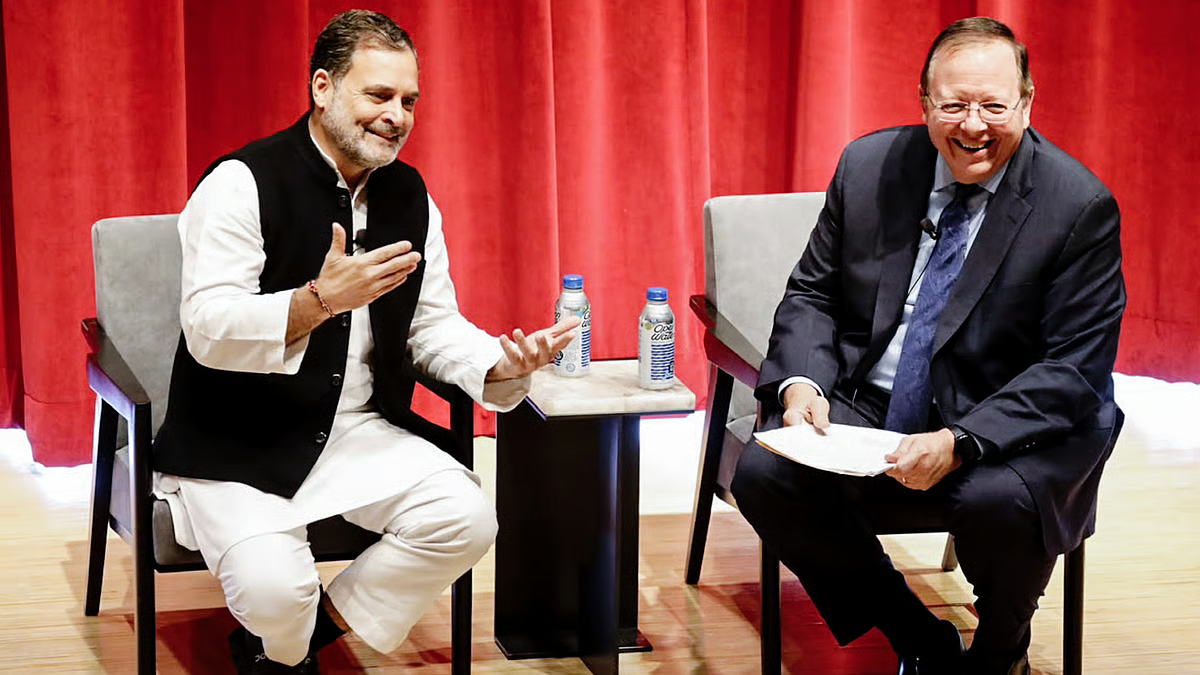
Rahul Gandhi says he is barred from interacting with students and faculty at Indian universities.
Describes the Congress as an 'unorganised party of resistance' and warns against underestimating grassroots mobilisation.
Calls for education reform, stronger manufacturing, curbs on monopolies and greater technological self-reliance.
Why is Rahul Gandhi called a youth leader at the age of 55? Why is the BJP better organised than the Congress? Why has the Congress split several times in the past, while the BJP has remained intact?
These were among the questions put to Lok Sabha Leader of Opposition Rahul Gandhi by the audience at the University of Chicago, where he participated in an hour-long interaction moderated by Professor Robert Pape.
The question-and-answer session followed a more structured conversation on the emerging global security architecture in the aftermath of conflicts in West Asia and the US midterm elections, and why India was missing from the table. The audience questions, however, focused largely on domestic politics.
What are three positive things you can say about India today, one attendee asked. It was a clever question from an NRI, who helpfully suggested the popularity of yoga as a possible answer. He possibly wanted the Congress MP to identify three positive developments under Prime Minister Narendra Modi. Gandhi fielded the googly, to borrow a cricketing term, with a straight bat.
India is one of the best in the world at managing complexity because of the way our system is structured.
— Congress (@INCIndia) November 19, 2026
Our plurality, democracy and ability to listen to different perspectives are what make us stronger.
Now, if you are attacking these very ideas in India, then how do… pic.twitter.com/Pr3v34fIwm
India has an immense capacity to deal with complexity, he said, adding that Indians were masters at navigating complex situations. The second positive he identified was the country's youthful population. Most Indians are young, hardworking and innovative, he pointed out. The third was India's deep and ancient philosophical traditions.
One of the reasons he had travelled all the way to the US to interact with students and faculty, Gandhi said, was that he was not allowed to do so at Indian universities.
"I can visit Cambridge, Columbia and Harvard, but I am not allowed to visit Delhi University and interact with students and faculty," he quipped.
What happened in 2014 was the fusion of the BJP's financial system with Adani's company. They've fused finance with politics and also established solid control over the media.
— Congress (@INCIndia) November 19, 2026
This concentration of economic and political power has allowed the RSS to place its people in all… pic.twitter.com/6Zmjj0CFOS
He has, however, found a way around this restriction by addressing thousands of students outside university campuses through the 'Chhatron Ki Goonj' programme in cities such as Kota in Rajasthan, Prayagraj (Allahabad) in Uttar Pradesh, Pune in Maharashtra, Indore in Madhya Pradesh and Chennai in Tamil Nadu.
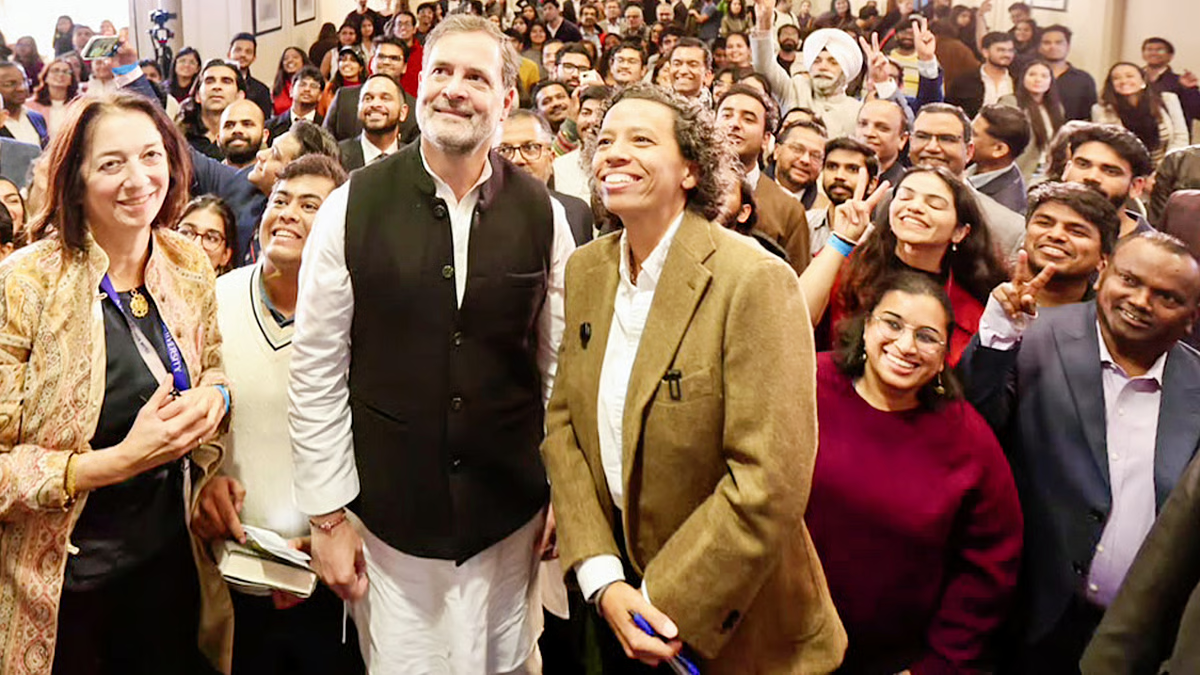
Here are some of the more interesting questions put to him, and his responses. The audience comprised a few hundred students, faculty members and invited guests.
Why are you called a youth leader at the age of 55, and why should India's youth accept you as a leader?
Perhaps it is because I am curious and ask questions. I have always questioned established norms. That is who I am. Society imposes norms on what you can do or say. Politics imposes norms, just as your PhD programme prescribes norms. I have never felt bound by them. I am curious about everything and ask a lot of questions. Isn't that what being young is all about?
"As politicians, we are used to telling people what we think is good for them. But during the Bharat Jodo Yatra, I began listening to people's thoughts.
— Congress (@INCIndia) November 19, 2026
That's when I discovered that, as a politician, you can build personal relationships with thousands of people."
Shri… pic.twitter.com/M3iqKyF50U
The Indian National Congress is called the Grand Old Party. Where are the young people in the Congress? The idea of the Cockroach Janata Party (CJP) came from a flippant comment by a young man in Boston, not from any youth leader in the Congress. While you talk about youth, doesn't the Congress seem out of sync with the young?
On the contrary, the Congress today is a very youthful party on the ground. You may not see them on television or hear about them, but they are there. We have an army of very talented and committed young men and women working in every district. You will hear about them, I can tell you that.
The Congress has split so many times in the past, but the BJP has not. The BJP also appears better organised. How do you hope to compete?
The Indian National Congress has always been an unorganised party of resistance. Even during the freedom struggle, the Congress was not regimented and did not function like an army. It was open to everybody, like a tent. People walked in and out.
I am also told how organised the BJP is. I know the money power it has. However, recall what happened at Jantar Mantar in June this year. A totally unorganised group of young people and students came out to protest. Who looked more powerful — the police or the protesters? The Union education minister was forced to resign by this unorganised group. Do not, therefore, underestimate the power of resistance.
In India, for example, ministers are now in touch with us. Insiders are giving us information from within the Election Commission. It is only a matter of time before the BJP caves in.
Effective political action can have a huge impact. The point is, are you doing the political action using non-violence?
— Congress (@INCIndia) November 19, 2026
Social problems are not going to be fixed by us simply sitting here and saying, "Let's fix them." They are going to be fixed by putting political energy behind… pic.twitter.com/VbwV5jAe7Q
You keep talking about non-violence as your strength, weapon and tool. But hasn't violence been normalised in India and Indian society?
Was there a single act of violence during the Bharat Jodo Yatra? There was none as I walked 4,000 kilometres. I am aware that in politics, people are expected to be loud, aggressive and violent. Talking about love, truth and non-violence appears out of sync with politics. But think of all the successful acts of resistance by people. They were all non-violent.
What policy reforms would a Congress government undertake to reverse the tide in India?
The foremost policy initiative has to be around education. Education is not accessible to a large number of Indians today. It is neither affordable nor relevant.
The second set of initiatives will have to address the production system. We have excellent engineers with no work. We cannot become a superpower on the back of services alone. We have to produce and get our hands dirty.
Monopolies will have to go, and there will have to be greater equity in society. While some people spend millions on weddings, a large majority are in distress. This cannot continue. India needs to retain its plurality and its ability to navigate diversity. Finally, we need to achieve mastery over some basic technologies.
Biggest policy reforms that are needed in India:
— Congress (@INCIndia) November 19, 2026
➡️ Giving our students back their biggest weapon - a strong education system.
➡️ Ensuring that educated people have access to respectable jobs.
➡️ Ensuring economic equality.
➡️ Most importantly, protecting plurality.
: Shri… pic.twitter.com/wykHnoykDF
Why is the Congress unable to publicise some of the good initiatives taken by Congress governments in Karnataka and Telangana?
The reasons are quite obvious. The BJP's finances are now intertwined with the financial power of monopolists and those who control capital. They also control the media. The RSS today controls all institutions. Almost all the vice-chancellors in India today have been appointed by the RSS. As a result, the good work done by Congress governments remains confined to its beneficiaries and does not reach a wider audience.

Comment
0Upholding journalistic discourse. No registration required.
No comments yet. Share your perspective!