

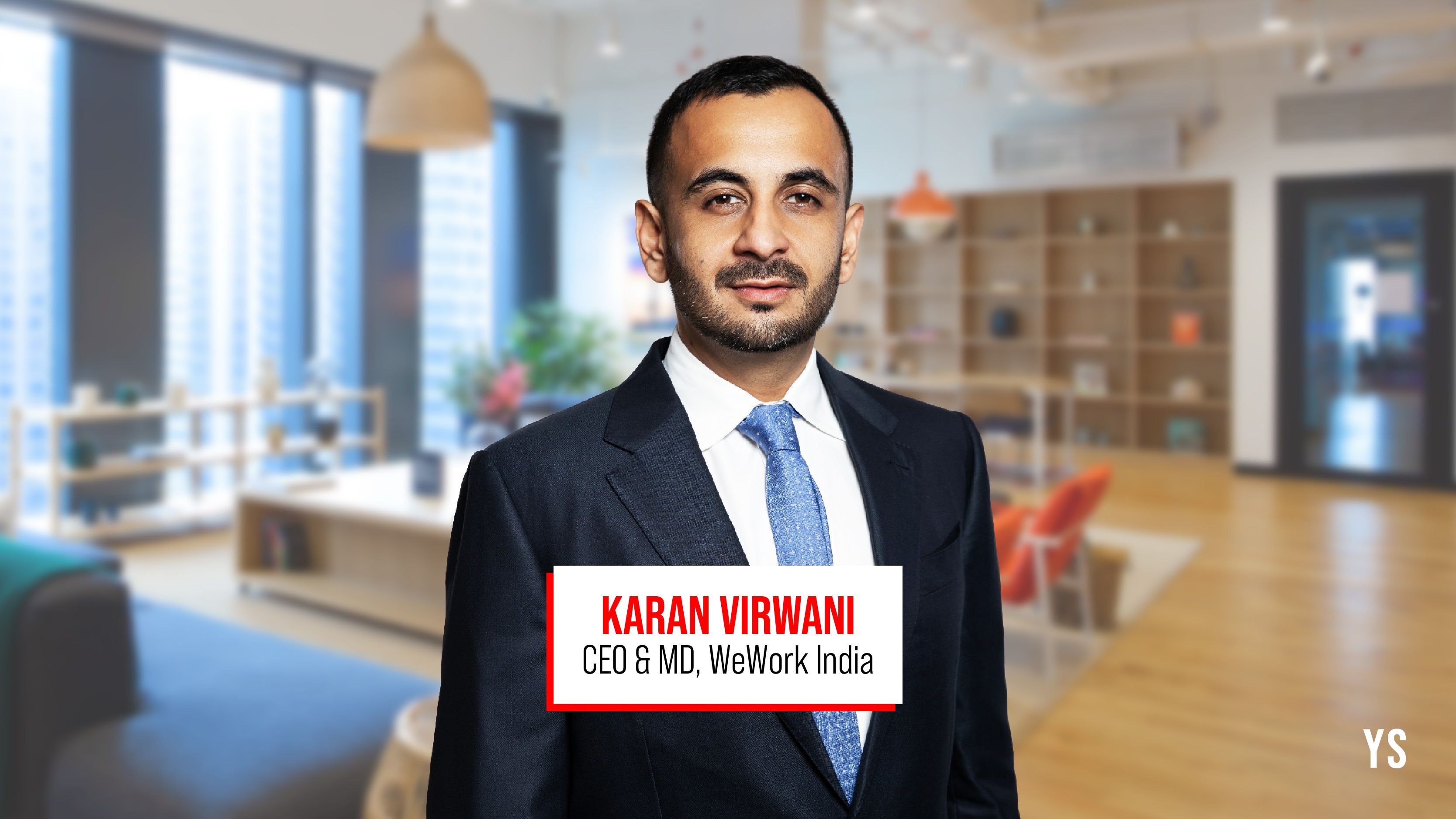

A year after WeWork India announced its IPO in October 2025, CEO and Managing Director Karan Virwani is satisfied with the company’s performance despite a subdued market.
“I think from an investor standpoint and a shareholder standpoint, we've done good. And if you compare it to the relative market, I think we've done really well,” he tells YourStory.
Virwani says founders spend much of their time raising funds and ensuring they have enough liquidity to sustain their businesses. Going public, he believes, removes some of that pressure, allowing them to focus on execution and growth.
“WeWork India has grown by 30%, both from a revenue perspective and an EBITDA perspective. Our digital products also crossed an annualised revenue run rate of Rs 100 crore. So we are doing pretty well,” he says.

Launching Rivet and expanding the product portfolio
Virwani says WeWork India’s digitally enabled products, including Virtual Office and Workplace, have performed well. The company earns more than Rs 100 crore in subscription revenue, with the business growing 30% year on year.
“We have been noticing this post COVID. People have been using our spaces on-demand, sort of like how one uses Uber. We own the plug-and-play co-working space sector completely. There’s no major competitor really,” he says.
The company’s managed offices business, which was a new vertical a few years ago, has also expanded.
“It’s grown to become 25% of our business. We did some really large deals this year with big players like T-Mobile, JPMorgan and Amazon.”
WeWork India recently launched Rivet, its design-and-build vertical, to serve existing customers who started with smaller workspaces but now require larger offices.
“Rivet was a way for us to take what they love about WeWork and design-build it for them specifically, based on their requirements and branding,” Virwani says.
He believes Rivet differs from other design-and-build companies because WeWork India also operates physical workspaces, rather than focusing solely on designing and handing over offices.
Working with GCCs and adopting AI
In its early years, particularly 2017 and 2018, WeWork India primarily catered to startups and freelancers. Today, nearly 50% of its business comes from global capability centres (GCCs), including large, mid-sized and smaller operations.
“A lot of these GCCs are in an exploratory phase when they enter a country like India. They’re starting or they’re testing if they can hire. They’re really seeing if this offshoring model works for them,” Virwani says.
He cites the example of Moss Adams, which has since merged with Baker Tilly under the latter’s name.
“They started with us with like 25 seats and now we've done a 600-person managed office for them. All in a span of roughly two years.”
Virwani is also optimistic about the opportunities created by AI. He says WeWork India has seen an acceleration in demand from a new group of AI-focused companies that have become its customers.
He believes AI is increasing the need for collaboration and, in turn, collaborative workspaces. He also expects entrepreneurship to grow faster over the next three years than it has in the previous three, as technology makes it easier for more people to start businesses.
“Those entrepreneurs will either join mid-sized businesses, smaller businesses, or they'll start their own businesses. And that will definitely benefit us because that's the type of audience that we're aimed at,” he says.
WeWork India has also introduced AI into its own operations, from routine tasks to more advanced applications. These include spatial analytics using CCTV footage to understand how people use its offices and improve workspace design.
“Contrary to popular belief, AI is not actually reducing our employee headcount. It's not like I can let go of a few hundred people. In fact, it's making everyone much more proactive. The quality of output has definitely increased,” he says.

Expansion plans and bigger ambitions
WeWork India currently operates across eight metropolitan markets: Bengaluru, Mumbai, Gurugram, New Delhi, Noida, Hyderabad, Chennai, and Pune.
Virwani says the company will consider expanding into other cities and towns when there is sufficient demand.
“I don't view it as Tier II or Tier III. Tomorrow, if any city starts to show a type of demand, which is a combination of enterprise and startups, and there is good supply coming in, we would 100% look at it as a serious growth city,” he explains.
For now, however, he would prefer to expand into areas on the outskirts of Bengaluru rather than enter an entirely new city. The priority is to operate where demand and supply are concentrated.
According to Cushman & Wakefield’s Global Trends in Flexible Office 2026 report, India ranks as the world’s most mature flexible office market.
Virwani expects the Indian market to double over the next five years.
“I really see the overall industry doubling in the next five years, which will mean that it’s roughly growing at about 20-odd per cent year on year. I see us trying to beat that growth, and so the business itself will more than double in that time period.”
He says WeWork India is evolving from a coworking space provider into an end-to-end real estate services platform.
While the flexible workspace sector has relatively low entry barriers, Virwani believes scaling a business remains difficult. He also sees enough room in the market for WeWork India and its major competitors to grow.
His mid-term ambition is to increase WeWork India’s market capitalisation from around Rs 10,000 crore to closer to Rs 50,000 crore.
“My aim or my dream would be that WeWork India becomes just the default. When you think of a workspace, you think of us,” Virmani says.
Edited by Teja Lele



Comment
0Upholding journalistic discourse. No registration required.
No comments yet. Share your perspective!