

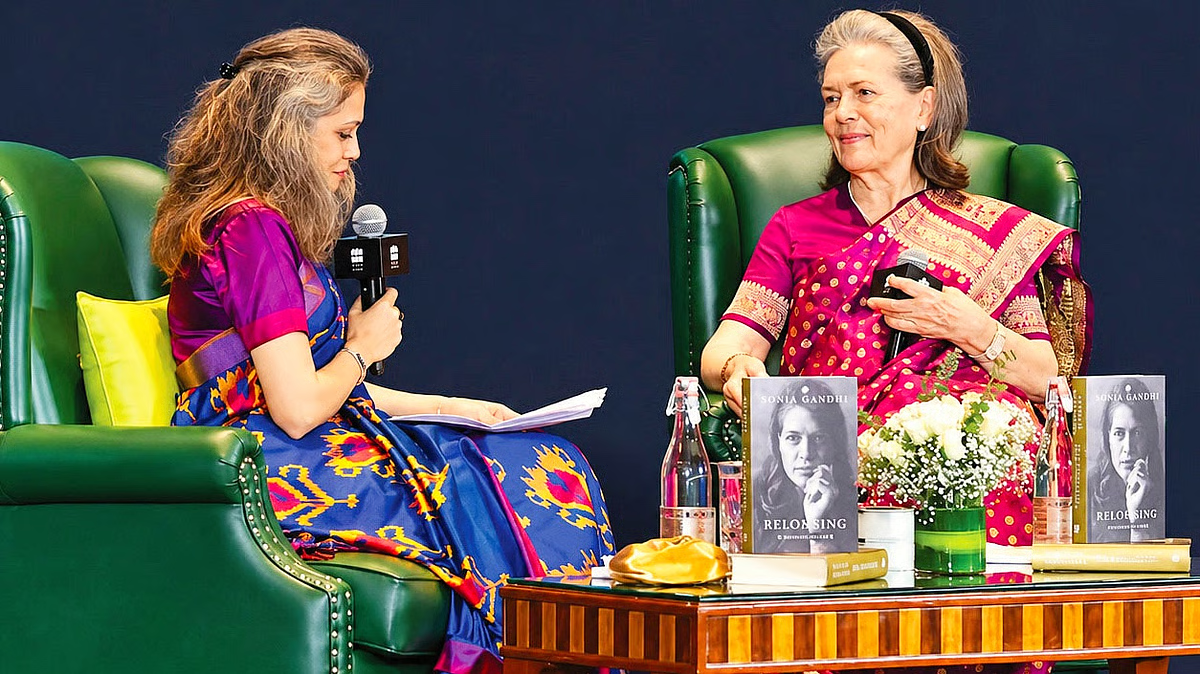
There is something deeply satisfying about the public response to Sonia Gandhi’s memoir Belonging: A Journey of Love. I see in this moment something much larger than the success of an autobiography. I see the spectacular failure of one of the most sustained character-assassination projects undertaken by India’s Hindutva establishment. A woman whom the BJP and the hydra-headed Sangh Parivar have tried for decades to humiliate, delegitimise and politically destroy has found a way to narrate her own story. And people are listening.
The Sangh Parivar has done its damnedest to manufacture a fictitious Sonia Gandhi. Not the woman who arrived in India through love, who embraced this country as her home, who endured devastating personal tragedies and eventually entered public life, but an entirely fictional character assembled with prejudice with dollops of insinuation and organised vilification.
For the Parivar, she was a bar dancer, an Italian stooge, a foreign conspirator plotting to appropriate India, a Christian agent out to convert Indians... These slurs were not uttered in the fever of an election; they constituted the vocabulary of a political campaign to question her place in this country, to cast her in the image of a hostile alien, to delegitimise her sense of belonging to India — the same politics of exclusion that has seen a million repugnant mutations.
What exactly is the crime of becoming an Indian through love and marriage, through an intimacy with its people that came through an immersion in the country’s extraordinary plurality? Is ‘Indian’ merely a geographical inheritance or more? Is it also a political and moral idea that people can consciously embrace? Must nationality be determined by birthplace, ancestry or religious identity? For the Sangh Parivar that has spared no effort to make Sonia Gandhi’s foreign origin the defining feature of her existence, her life poses these questions with a discomfiting insistence.
Her commitment to secularism and India’s pluralistic imagination is even more consequential at a time when millions of Indians find their sense of belonging to this country being challenged by the majoritarian politics of the current regime.
The irony is magnificent: the woman they tried to imprison in a fabricated story has now written her own.
The difference between the two projects is unmistakable. The Sangh Parivar’s Sonia Gandhi was manufactured through TV propaganda, political invective and relentless insinuation. The Sonia Gandhi of Belonging speaks through personal experience, emotional vulnerability, memory and the authority of lived history. One is a political caricature designed to provoke hatred, the other is a human being reclaiming her voice.
****
What touches me most about Belonging is the absence of bitterness. A woman who has endured so much hatred has not allowed bitterness to become the defining emotion of her existence. There is something profoundly human and beautiful about that. It is perhaps one of the most difficult forms of courage: to be wounded without losing tenderness and to encounter hatred without surrendering one’s capacity to love.
Her memoir, therefore, is also an invitation to understand the human being behind the public figure.
I particularly appreciate the courage involved in critically revisiting her own life and the decisions of those closest to her. To acknowledge mistakes made by her husband, her mother-in-law or her own political establishment couldn’t have been easy. It requires a certain moral centre, a willingness to place truth above sentiment and history above family pride.
The Sangh Parivar’s problem is not merely that they disagree with Sonia Gandhi. They also seem unable to accept the possibility that a woman they have relentlessly vilified might command affection, respect and now the attention of millions of readers. Which brings me to the evocative title of the memoir and the question it grapples with.
A country is not made one’s own by birth alone. Belonging can come through love, commitment, sacrifice and an enduring emotional attachment to its people. Sonia Gandhi has lived that journey. Her Indianness must be understood through the life she chose to live here, the losses she endured here, the responsibilities she accepted here and the political values she continued to defend here.
I have never believed that Sonia Gandhi is beyond criticism; no political leader should be. The Congress must answer for its mistakes, and the Nehru-Gandhi family must be subjected to the same scrutiny as any other powerful family. But holding people up to standards is one thing and politically motivated vilification quite another. Political disagreement should never erase human dignity.
Sonia Gandhi’s Indianness must be understood not through her birth but her embrace of the idea of India, her commitment to the idea that shaped her public life. She fought for the idea through strife and political defeats, she remained a binding force when political adversity tested people of weaker resolve, and she never saw the country merely as a political arena.
The memoir is touching because it lets you in, it allows you to glimpse fragility, to encounter a woman who has lived an extraordinarily difficult life but recalls it with no bitterness. It invites you to see her life not through the offices she held, nor her political victories or defeats but through what she endured, what she refused to surrender and what remained of her after everything she had been through.
Perhaps the most beautiful thing about Sonia Gandhi is that after all these years of being told that she does not belong, she has continued to live, love and work for an India in which everyone has the right to belong. That is why I believe Belonging should be read with an open heart.
****
The extraordinary public response to the book is politically significant as well. Readers are queuing up and copies are reportedly disappearing from the shelves. The attention it is getting across India and abroad is not just the curiosity to peek into the private life of a public person; it is also an appetite to discover the truth of a story that has been appropriated by others for far too long.
The BJP’s response is equally revealing. Even as sales break all sorts of records and the book becomes a runaway success, the hate factory is hard at work trying to find something that might give their propaganda fresh legs.
I celebrate Sonia Gandhi’s memoir because it is a refusal to surrender her identity to the machinery of hatred, because it challenges the arrogant assumption that her sense of belonging can be questioned by those who hate her, that her life can be defined by those who will never get her.
Edited excerpts from two pieces originally posted on the author’s Facebook wall
K.A. Shaji has chronicled rural distress, caste and tribal realities, environmental struggles and development fault lines. More by the author here





Comment
0Upholding journalistic discourse. No registration required.
No comments yet. Share your perspective!