

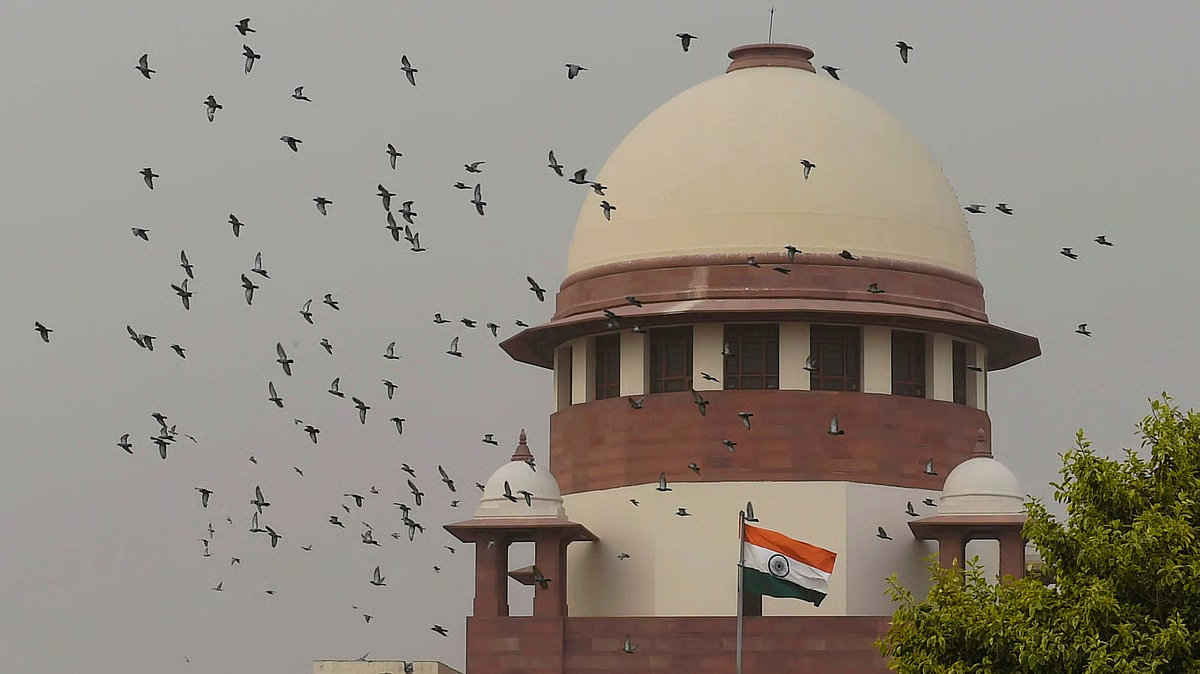
Supreme Court says India's sanitation performance remains poor despite its economic growth.
It asks district collectors to take a lead in enforcing solid waste management rules.
The bench flags gaps in monitoring, public-private participation and corporate social responsibility.
The Supreme Court has said India is now a rich country but continues to have poor sanitation performance, flagging the failure to effectively implement solid waste management rules despite the country's economic progress.
Hearing appeals arising from orders of the National Green Tribunal concerning compliance with environmental norms by municipal corporations under the Solid Waste Management (SWM) Rules, a bench of justices SVN Bhatti and NV Anjaria said the initial steps of setting up an administrative mechanism to monitor implementation were in place.
"The court notes that Bharat is now a rich country but has poor sanitation performance. The growth achieved in other fields is completely negated by the negative impact from this manageable dereliction by all the stakeholders," the bench said in its November 17 order.
The top court said poor sanitation and solid waste management affected the image of society and the country, adding that economies of comparable size, both within India and abroad, had succeeded in achieving their sanitation and hygiene objectives.
"Our existing resources make it possible, albeit through unwavering implementation by the statutory enforcing authorities and adherence by the citizens," it said.
Reviewing reports submitted by the Supreme Court Monitoring Committee (SCMC), the bench observed that different organs of the State were working independently rather than towards a common objective.
"The cogs (citizens) that connect them must work towards the objective for realising good results," it said.
The bench noted that while Parliament had enacted the Environment (Protection) Act, 1986, and the executive had framed the SWM Rules, implementation of the 2016 and 2026 rules continued to fall short of the objectives set by Parliament.
"Therefore, this court, as a repository of the constitutional right to a pollution-free environment, through SCMC, has taken the arduous task of issuing continuing mandamus to the local bodies," it said.
The court said its intervention through the SCMC was not an attempt to take over the responsibilities of other institutions, but an effort to ensure that the rules were implemented.
"As already noted in our earlier orders, it is now or never. The SCMC's efforts will sunset into self-regulation by the contributors," the bench said.
It acknowledged the scale of the problem and the efforts required to address it, while expressing confidence in the SCMC and district collectors across the country.
The bench said it had relied on district collectors after witnessing the effective implementation of the rules by two or three collectors in different states.
It described the order as a reminder of the Supreme Court's expectations from district collectors and their ability to deliver results, warning that failure to act would make the situation worse and potentially irreversible.
The court asked district collectors to devise strategies suited to local requirements and work dynamically with chief secretaries and the SCMC to implement the 2026 rules and its directions.
Flagging shortcomings in the monitoring process, the bench recalled that it had noted on August 18 that unorganised residential, commercial and business establishments accounted for a major part of the problem.
It said the SCMC report did not provide details of notices served or additional areas identified for possible temporary disconnection of water and electricity to ensure compliance with the rules.
The court also flagged the absence of a clear plan for public-private participation, which had been proposed to ease the financial burden of improving waste management infrastructure.
It further said the SCMC report did not address the statutory framework needed to use corporate social responsibility (CSR) funds to strengthen infrastructure.
The bench said industries could not claim that pollution was generated in one place while their CSR contributions were made elsewhere.
Issuing additional directions to address the shortcomings, the court posted the matter for further hearing on January 12.
On August 18, the top court had issued a series of directions for the management and disposal of solid waste, saying infrastructure needed to be scaled up to meet the standards prescribed under the SWM Rules, 2026.
It had also criticised the prevailing public attitude towards waste generation, observing that the general feeling across society was: "I am entitled to generate but not to cooperate and control the impact of solid waste management at the threshold".
The proceedings originated from a challenge by the Bhopal Municipal Corporation to directions concerning its obligations in handling municipal solid waste. The Supreme Court later expanded the scope of the matter nationwide, citing the lack of a sense of compliance with the rules.
The SCMC was constituted pursuant to an earlier direction of the apex court and includes several Union government secretaries and the secretary of the Central Pollution Control Board (CPCB).
The bench has directed district collectors to identify all bulk waste generators in their respective jurisdictions in coordination with local bodies.

Comment
0Upholding journalistic discourse. No registration required.
No comments yet. Share your perspective!