

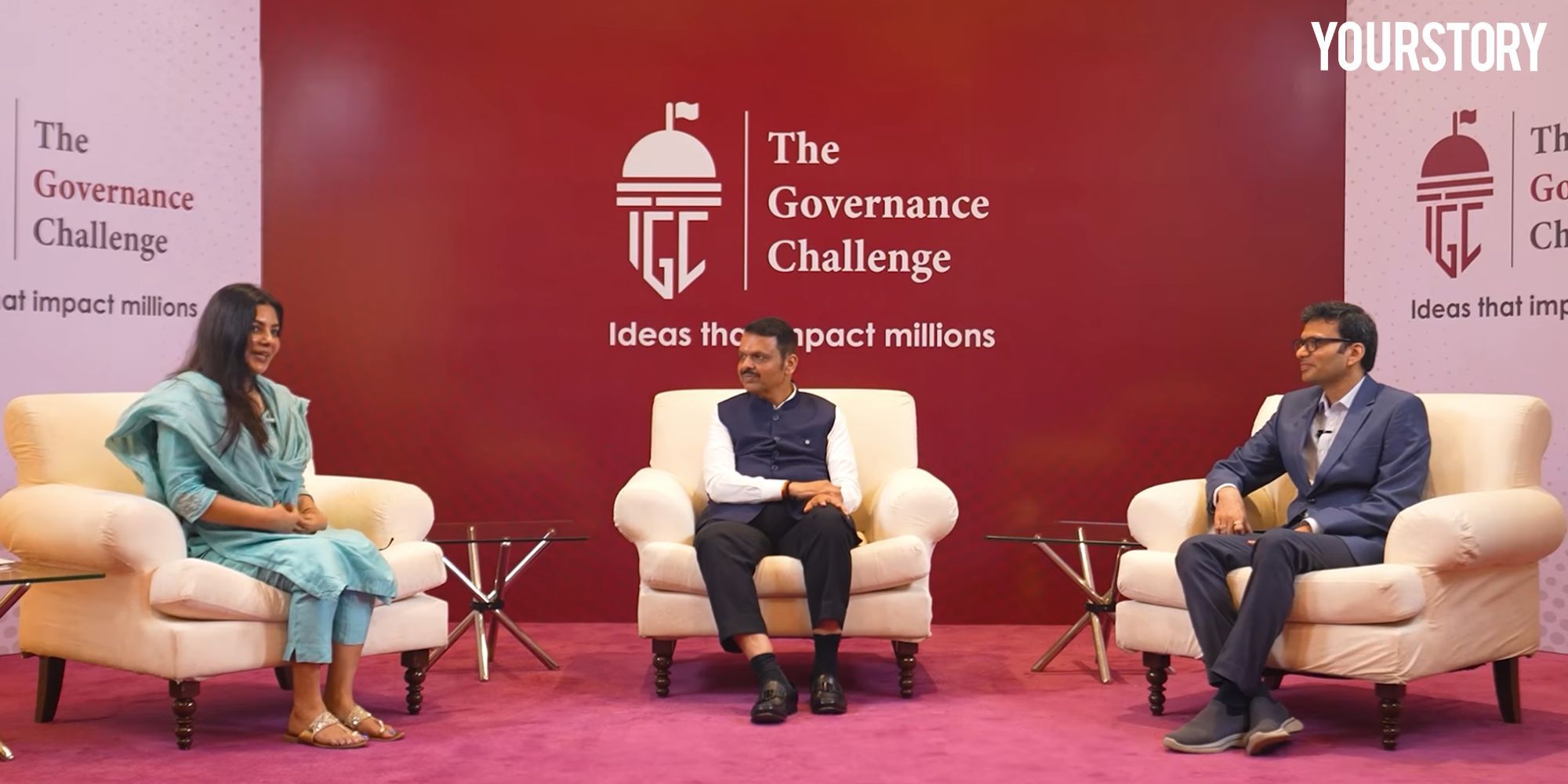

Few sitting Chief Ministers would spend four to five hours judging student presentations. Devendra Fadnavis did exactly that at the summit of The Governance Challenge (TGC) 2026 in Mumbai, where six finalist teams pitched their answers to one question: what can the Government of Maharashtra do to make the state an innovation hub by 2035?
The challenge drew more than 4,400 three-member teams, over 13,000 students from 30 of India’s leading business and policy schools. After several elimination rounds, six teams presented ideas on healthcare, education, farming and access to credit. The Chief Minister, the 18 finalists and Gaurav Goel, founder of Samagra, which runs the challenge, then joined Shradha Sharma, Founder & CEO at The Bharat Project, YourStory Media for an open conversation.
A government willing to admit it doesn’t have every answer
Fadnavis opened with an unusually candid view of how governments tend to think.
“Normally, in government, we always feel that we know everything, and that we are the ones who will create solutions for every problem. But in my experience of the last 10 years, I feel you need a very fresh perspective to look at every problem.”
The finalists, he said, brought exactly that. They understood technology and how to deploy it, and despite being outsiders to the system, they had clearly thought hard about the problems. Their ideas may not be complete solutions, he added, but they give the government a strong base to build on with its own experience and data.
Why B-schools need a dose of governance
Goel explained that TGC was created to fill a gap in management education. Business school case studies, campus events, internships and placements all lean heavily towards the corporate and startup world, leaving students with little exposure to governance or social impact. TGC tries to change that through immersion, in the hope that the experience stays with students and later draws them towards nation-building.
After the national round, finalists spent two days meeting officials across departments and visiting model schools and primary health centres, while mentors from government and industry helped refine their pitches. The students said the visits upended their assumptions. One admitted that problems look simple from the outside, and that proposing a fix from an air-conditioned room is very different from delivering it on the ground. He was struck by how much infrastructure already exists, including 3D printers in government schools. Others said the competition felt different from the usual hackathons because it pointed towards execution, not just a certificate, and that some teams worked until 3 am refining their ideas.
An 11-year experiment with young talent
For Fadnavis, young people in government is not a new idea. Since 2015, the Chief Minister’s Fellowship, run with IIT Bombay, has placed bright young graduates inside government for a year through a competitive selection process. Some leave jobs at multinationals to join.
One fellowship team built a platform to run and evaluate the state’s farm-pond-on-demand scheme for drought relief and water conservation. The scheme created around 1.5 lakh farm ponds, and the platform won a Prime Minister’s Award. Senior bureaucrats who were sceptical in the early years now compete for fellows, with district collectors asking for two or three at a time.
In 2019, the state also launched a Village Social Transformation initiative with CSR partners across 1,000 villages, asking young people to live in a village for a full year and use CSR funds to fill gaps that rigid government budgets could not. Of 5,000 applicants, roughly 900 to 950 took up the challenge, and not one dropped out.
Goel said Samagra runs on the same belief. Its team of 90 to 100 people has had an average age of 25 to 30 for over a decade. He looks for energy, an impact orientation and raw smarts, and says young recruits are easier to groom because they arrive without baggage.
Experience plus fresh ideas
Fadnavis called Gen Z the first generation born entirely into technology and constantly connected to global best practices. Properly channelled, he said, that exposure produces bright ideas. But he stressed balance: new ideas need mentoring and oversight, and real innovation comes from pairing fresh thinking with experience.
Maharashtra in 2035
Asked what transformation he wants the state to be known for, Fadnavis began with the government machinery itself. Its people, he said, are its most neglected resource, and good work too often depends on an individual minister or officer rather than the institution. Building the state as an institution, with Samagra’s help, is now a priority.
He then set out the economic goal. Maharashtra is a $660 billion economy that he believes can overtake the UAE and Singapore within two years and become India’s first trillion-dollar state economy by 2030. A true welfare state, he argued, must earn before it spends on social programmes. With the state already about 50% urbanised, he wants that urbanisation to drive jobs and sustainable growth.
His vision for 2035 includes a drought-free Maharashtra with water reaching every area, 65% of power from clean sources, and a state that serves as India’s home for startups, frontier technology and deep tech.
Skills over degrees
His advice to students was to stop chasing degrees for their own sake. Future jobs, he said, will depend on the skills people actually acquire. A skilled workforce attracts investment, and investment creates demand for more skilled people. Getting that cycle right would put Maharashtra in a different league.
Innovation for the village
When a student asked what innovation means for a villager with little exposure to technology, Fadnavis gave the line of the day.
“Innovation is a simple solution for a very complex problem. Unless it is a simple solution, it is not an innovation.”
He pointed to the state’s AI advisory tools for farmers and AI models already lifting farm productivity. The problem is that many depend on costly IoT hardware that a farmer with one acre cannot afford. The next round of innovation, he said, must make these tools cheaper and more sustainable.
Purpose first
In closing, Fadnavis told the students that serving the nation does not require a uniform or public office.
Creating jobs, improving livelihoods, lifting people out of poverty and extending healthcare are all forms of service, in any field. Whether they build a startup or chase a unicorn, he urged them to anchor their work in purpose, because purpose matters more than how much they earn.
Shradha called the day a glimpse of what a Viksit Bharat could look like: a Chief Minister who listens, and young people ready to do the work.