

Indian newspaper headlines claiming US court had 'ordered' Indian courts to serve summons on NSA Ajit Doval and former R&AW chief Samant Goel are sensational and misleading.
The Southern District Court of New York has used the phrase 'respectfully requests' in seeking the assistance of Indian courts to serve the summons in accordance with the Hague Convention.
A US federal court in Washington issued summons to then PM Manmohan Singh in 2013. There are other precedents for foreign courts serving legal notices on Indian nationals.
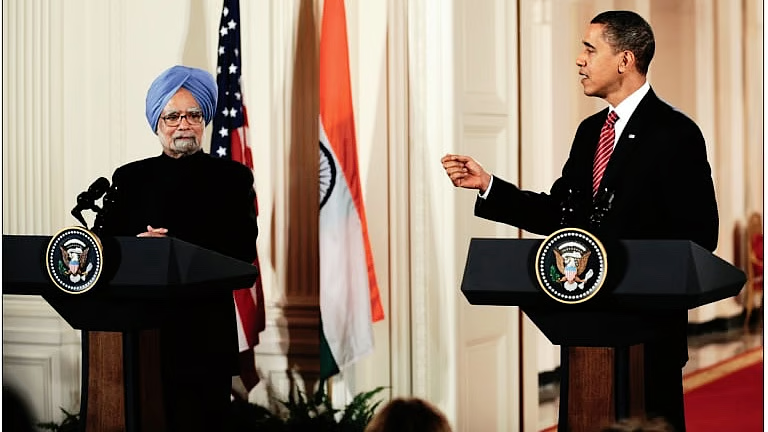
Then Prime Minister Manmohan Singh received a summons in September 2013 from a US federal court in Washington, DC, in a lawsuit filed by Sikhs for Justice and others. The complaint alleged that, as finance minister in the 1990s, he had helped fund counterinsurgency operations in Punjab that resulted in human rights abuses. It further alleged that, as prime minister, he had helped protect individuals accused of involvement in the 1984 anti-Sikh riots. Attempts were also made to serve the summons while Singh was visiting the US for meetings with then President Barack Obama.
While it is unclear where and when the summons was ultimately served on the then prime minister, the trial proceeded in Washington, suggesting that service was successfully effected. In 2014, while Singh was still in office, the US State Department and the Department of Justice filed a petition arguing that he enjoyed immunity from prosecution. They maintained that, as head of government, he was immune from proceedings relating to official acts performed while serving as prime minister.
The court ruled that while immunity covered his actions as prime minister, allegations relating to his tenure as finance minister needed to be considered. The proceedings were eventually closed.
The US federal court's 'respectfully requests' to courts in Delhi — the Patiala House Court in Doval's case and the Dwarka and Saket courts in Goel's case — are, therefore, not without precedent.
US courts routinely serve legal documents on Indian companies, directors, executives and private citizens through the Hague Service Convention in cases involving contractual disputes, securities litigation, intellectual property and product liability. This has been standard practice since India joined the Convention in 2007.
India and the United States are both parties to the Convention on the Service Abroad of Judicial and Extrajudicial Documents. The treaty provides a mechanism for courts in one member state to serve legal documents in another. India has designated the Ministry of Law and Justice as its Central Authority for handling requests under the Convention.
It was after earlier attempts to serve the summons on the NSA and the former R&AW chief failed that US federal judge Katherine Polk Failla concluded that Indian procedural law and the Constitution permitted the transmission of the summons through courts in Delhi.
Even when a summons issued by a foreign court is successfully served, it merely establishes that a lawsuit has been filed abroad and that the defendants have been formally notified of the proceedings. Service of a summons neither validates the allegations nor establishes the guilt of the defendants.
As in Singh's case, immunity for acts performed in an official capacity is likely to be a central defence argument if the present case proceeds to trial. The allegations against India's national security advisor and the former chief of its external intelligence agency have been levelled by US-based attorney Gurpatwant Singh Pannun, who is of Sikh origin. Pannun has filed a civil suit against the two officials, alleging that they orchestrated a plot to assassinate him in the United States. He has sought damages and compensation through the lawsuit.
The US government is not currently a party to the civil case. The Indian government considers the allegations flimsy and frivolous and has questioned the possibility of serving the summons through courts other than the designated channel of the Ministry of Law and Justice.
Meanwhile, Indian businessman Nikhil Gupta, who has pleaded guilty to his role in the alleged assassination plot against Pannun, is expected to be sentenced in New York this week in a criminal case brought by the FBI, a US federal agency.




Comment
0Upholding journalistic discourse. No registration required.
No comments yet. Share your perspective!