

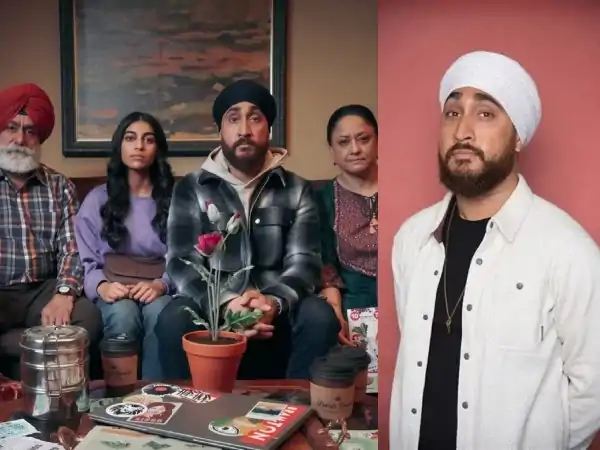

For years, Jasmeet Raina, better known as Jus Reign, has used comedy to capture the peculiarities of growing up in a Punjabi household in Canada. His YouTube sketches, built around familiar family dynamics, cultural differences and the everyday experiences of South Asian children growing up abroad, found an audience far beyond what he had initially imagined.
With his show Late Bloomer, he has taken that world beyond short-form comedy and into a more personal, layered narrative. The Canadian comedy-drama, which draws on his own experiences and those of people around him, follows Jasmeet Dutta, a Punjabi Canadian navigating his ambitions, family relationships and cultural identity.
After its first season became available to Indian audiences, the series returned with its second and third seasons, which are now streaming on OTT.
View this post on Instagram
In an exclusive conversation with Filmfare, Raina, who created the show and also stars in it, talks about the response in India, drawing from personal experiences, the importance of representation for South Asian children growing up abroad and navigating his own Kashmiri-Punjabi identity.
The Response to Late Bloomer in India
The response from Indian viewers has been encouraging for Raina, who says the demand for the show was evident even before it arrived in the country.
"I've been getting so much more response than I thought I would. Even before the show was out in India, every third or fourth DM I received was practically a death threat from someone in India saying they needed to watch the show and asking how they could watch it legally. It is more of a diaspora story, but it's very universal. People in India can relate to it in the same way they related to a lot of the stuff I did on YouTube."
How Much of Jus Reign's Life Makes It Into Late Bloomer?
The show draws considerably from Raina's own experiences, but not every character or storyline is autobiographical.
"A large part of my character's experiences comes from my own life. The other characters are more inspired by observations of people around me. Some of the other writers have also contributed their stories and experiences. It's been a good collection of experiences. The fun challenge has been figuring out the best way to share these stories because there are so many of them and so little screen time."
That overlap between real life and fiction has also made certain moments particularly emotional to execute. He explains:
"In the last couple of episodes of the first season, we see the father and son have a fallout. Those scenes were particularly emotional to write and act in, not just for me but also for Baljinder Singh Atwal, who plays the role of the father. We had a rather strange, out-of-body experience while doing those scenes. It was emotionally heavy for us, and I knew it would be difficult for audiences to watch because I don't think we've necessarily seen a lot like this."
"In the last couple of episodes of the first season, we see the father and son have a fallout. Those scenes were particularly emotional to write and act in, not just for me but also for Baljinder Singh Atwal, who plays the role of the father. We had a rather strange, out-of-body experience while doing those scenes. It was emotionally heavy for us, and I knew it would be difficult for audiences to watch because I don't think we've necessarily seen a lot like this."
View this post on Instagram
The second season also brought another deeply personal experience through a flashback episode featuring a younger version of Jasmeet during the period of the September 11 attacks. Raina was involved in writing and directing the episode, even though he did not appear in it himself. The younger Jasmeet is played by Jordan Sonny.
Raina continues:
"Directing that episode was quite an experience. Jordan did an amazing job. It felt like I was watching a younger version of myself because even his mannerisms were so similar to what I was like at that age. It was strange to see that and, in a way, relive those memories through someone else."
When Comedy Becomes a Way for People to Feel Seen
Long before Late Bloomer, Raina's YouTube videos had become a point of connection for many young South Asians growing up outside India. Some of the most meaningful responses have come from viewers who grew up in places where they had little access to a larger South Asian community.
Recalling the response to his videos, he shares:
"People used to tell me, 'Oh my God, you're funny. You made me feel seen.' Some of them were kids when I was making videos, and now they're in their twenties. They tell me I raised them and made them feel seen. At the time, I was making videos to make myself and my friends laugh. That was the goal. But they ended up reaching a much larger audience."
The connection was particularly significant for viewers who grew up in smaller towns across Canada and the United States, often without many people who shared their cultural background.
"I grew up in a town where there weren't many desis around. So, seeing messages from people who grew up in the most random cities in Canada or the US, where they didn't really have that community, and hearing that they could watch these videos and feel seen and connected is special."
He adds:
"I know a lot of people who would show my videos to their white friends, and they would say that they understood it now. I remember being around the city and having the most random people come up to me. Once, a man in his sixties from a small town called Sarnia recognised me. His wife told me he watched all my videos. He said, 'You know what I've realised? You Indians, you're pretty much like us. You're so similar.'" (laughs)
The Representation He Grew Up Watching
Today's young South Asians growing up abroad have a wider range of creators and artists reflecting their experiences. Raina, however, remembers having very few such figures to look up to while growing up. One comedian, in particular, made a significant impression on him.
"There wasn't that much when I was growing up. One of the most notable people was probably Russell Peters. When his stand-up came out, when I was in high school, it was a game changer. He was the first diasporic Indian guy I'd seen making such big moves."
Peters now serves as an executive producer on Late Bloomer.
Raina's own relationship with identity was shaped by several cultural influences. Growing up in Canada with Kashmiri and Punjabi roots, he was surrounded by different versions of the language and culture.
"I was definitely a confused kid. I'm Kashmiri-Punjabi, but a lot of the kids around me were from Punjab and spoke Punjabi. I felt a kinship with them, but then I'd realise that my dialect, or some of the words I used, were a little different. I didn't quite understand what was going on. I didn't even understand that there were different dialects of Punjabi because they all sounded the same to me. I also grew up knowing Hindi from watching Bollywood films. Everything was an amalgam. I could understand different languages, but when I was younger, it was difficult to distinguish between them."
View this post on Instagram
He remembers one particularly amusing incident from kindergarten, when he assumed everyone around him would understand Punjabi.
"I remember going to kindergarten and just starting to speak Punjabi because I assumed everybody would know what I was saying. They were like, 'Oh, throw this kid into ESL. This kid needs English!' My dad's Punjabi is different from my mom's, which is different from the Punjabi spoken elsewhere. I grew up around all of it and soaked it in. I can code-switch depending on who I'm speaking to and move into a different dialect. Even the mother on the show speaks the same dialect as my mom."
Could Diljit Dosanjh Appear in Late Bloomer?
Raina has previously spoken about wanting to write a part for Diljit Dosanjh in the series. While the possibility remains open, it is not something that has materialised yet. "It's a part for a future episode that hasn't been made. I think it would be nice. It would be cool to write and direct something for him from the perspective of somebody who was born and raised here. I know he does serious roles, but seeing him through that lens could be a cool mash-up, if it's something he's open to."
Interestingly, the two have not even met yet.
"No, I've actually never met him or spoken to him in my life."
With three seasons of Late Bloomer now out, viewers are already looking ahead to what comes next for the series. Raina is hopeful that the story can continue in some form, although nothing has been confirmed.
"Yeah, we're going to try to make it happen one way or another, if we can, whatever shape that takes. I have a couple of things cooking that I'm developing and am excited to hopefully get to. I also know a lot of people have been missing me on YouTube, so maybe we'll see something there."
Late Bloomer is now streaming on Lionsgate Play.
Comment
0Upholding journalistic discourse. No registration required.
No comments yet. Share your perspective!