

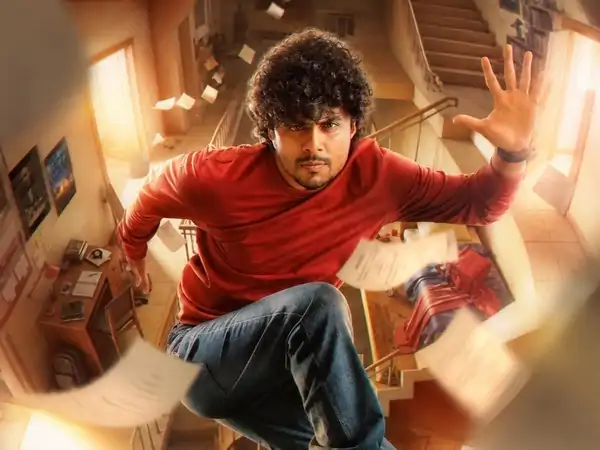
 Samson Joseph has two things going against him: a filmmaking career that refuses to take off and a life that seems determined to keep him in place. He takes up delivery work to support himself, while his aspirations remain frustratingly out of reach. Cosmic Samson finds an entertaining way to disrupt this routine. A pair of shoes gives Samson extraordinary speed, turning a man who has struggled to get ahead into someone who can suddenly leave everyone else behind.
The idea has a natural comic appeal, but it also gives the film an opportunity to explore the relationship between ability and ambition. Samson has spent years trying to make something of himself. His new powers offer a shortcut in the physical world, but they cannot automatically resolve the disappointments that have shaped him. The film's early portions are enjoyable because they allow this contradiction to play out without making Samson an instantly assured superhero.
Sandeep Pradeep is central to that appeal. He gives Samson a slightly uncertain, unassuming quality that makes the character's discovery of his abilities feel convincing. There is a welcome lack of grandiosity in his performance. Samson is excited by what he can do, but he is also a man who has spent enough time being disappointed to know that one lucky break may not change everything. Sandeep brings a good balance of frustration and enthusiasm to the role, and his physical performance gives the action a credible centre.
The powers themselves provide the film with its most useful source of invention. Samson's speed changes the rhythm of the action, and the better sequences make his ability part of the choreography rather than treating it as a simple advantage. Vlad Rimburg's action direction gives these passages a brisk energy. The film is at its most entertaining when it finds humour in the practical use of Samson's powers, allowing the superhero fantasy to retain a sense of play.
Yet the screenplay does not make enough of the possibilities it introduces. The shoes could have become a source of complications, forcing Samson to rethink his approach or making his abilities unreliable at crucial moments. Instead, the rules governing his powers remain insufficiently developed. The film has a distinctive mechanism at its centre, but it often uses it merely to move the plot along. What should be a defining element of the story becomes an occasional convenience.
The larger narrative also struggles to find a compelling direction. Samson's professional frustrations and family circumstances establish a relatable character, but the film gradually shifts its attention towards revenge. The change in tone is not inherently a problem. A superhero story can become darker as its protagonist confronts the consequences of violence. Here, however, the screenplay relies heavily on brutal incidents to establish the stakes, particularly through the suffering of women and children. The material is disturbing, but its repeated use does not necessarily make the conflict more meaningful.
The antagonists are another limitation. Their capacity for violence makes them dangerous, but the film gives them little beyond that. They do not develop into memorable personalities, and their conflict with Samson rarely becomes more interesting than the need for him to stop them. The action may provide a physical challenge, but the dramatic opposition remains thin. Without a stronger sense of what drives these characters, the revenge plot feels like a familiar route the film takes because it has run out of ideas for its more unusual premise.
This is where the film's second half loses some of the charm of its opening. The everyday humour and Samson's gradual discovery of his powers give way to a succession of confrontations. The climax has energy, but the emotional journey leading into it is not developed with enough care. Samson's transformation could have forced him to reconsider what he wants from life and what he is willing to sacrifice. Instead, the final stretch is more concerned with bringing the revenge story to its expected conclusion.
The technical work helps keep the film engaging through these uneven passages. Deepak D Menon's cinematography gives the fantasy a grounded visual setting, while Chaman Chakko's editing maintains a brisk pace during the action. Sibi Mathew Alex's score adds urgency, though it occasionally pushes moments that would have benefited from a lighter touch.
The supporting cast lends warmth to Samson's world. Mukesh brings affection to his role as Samson's father, while Miya George contributes to the family dynamic. Anuraj OB provides comic support as Samson's friend. Vedhika Sreekumar makes a strong impression in the more emotionally charged portions, bringing an intensity that stands out even when the writing does not give the surrounding material enough depth.
Also Read: Tom Hanks calls Aamir Khan's Laal Singh Chaddha 'a glorious thing'
Cosmic Samson has a likeable protagonist and a superhero concept that could have supported a more distinctive film. Sandeep Pradeep makes the character engaging, and the action occasionally finds an identity of its own. But the screenplay gradually abandons the playful possibilities of its premise for a revenge story that offers little freshness. The result is an entertaining fantasy in parts, though one that never quite fulfils the promise of its central idea.





Comment
0Upholding journalistic discourse. No registration required.
No comments yet. Share your perspective!