

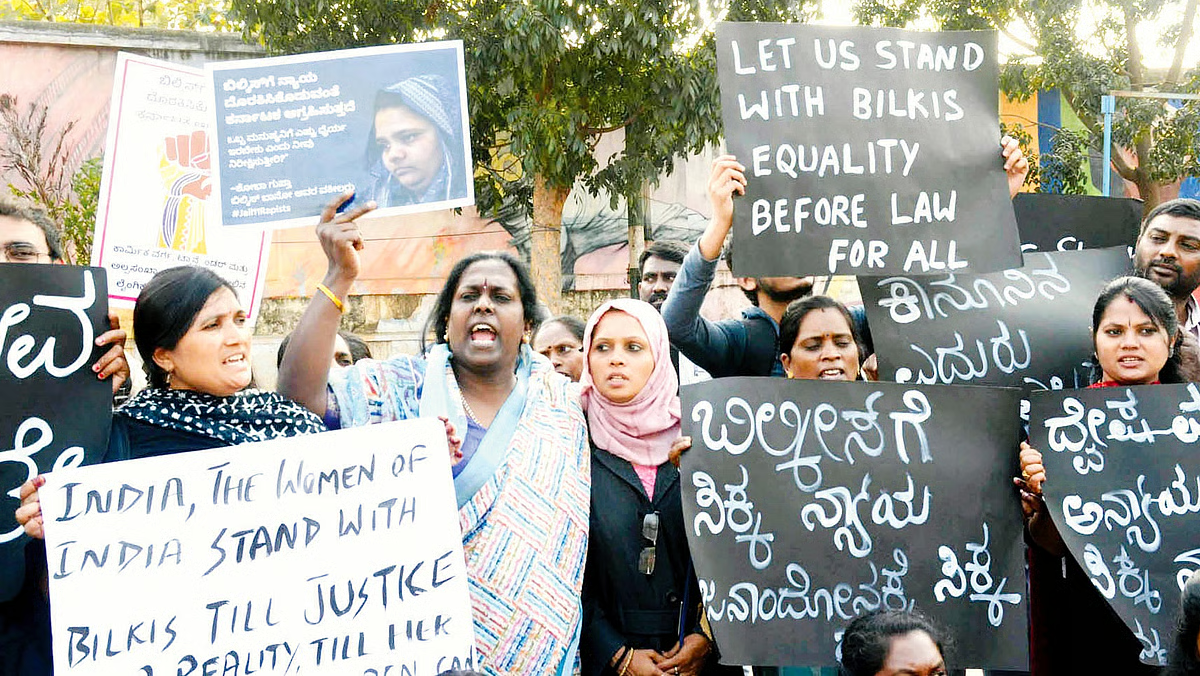
The Supreme Court Rules state that in an appeal against conviction, a ‘certificate of surrender’ must be submitted first, even before the appeal is listed before a bench. If the convict has not surrendered, he must show good reason and ask for a formal exemption, which is not easily granted in serious crimes.
Criminal appeals, even after being admitted to the court’s docket, take a very long time to be decided. The convict returns after serving a few years of jail time to ask for suspension of sentence. He pleads that his appeal is pending and that he has served 2/3 years in jail. The courts might summarily say: ‘Come back after another year.’
There is an odd contradiction here: the court has found enough substance in the appeal to admit it to its docket, but is also aware that given the backlog of cases, if the convict is let off at the outset while his appeal is pending, he might never fully be brought to justice if eventually found guilty. So, the courts have devised an informal, discretionary method of punishment, a compromise in a judicial system that cannot promise quick resolution of cases. Here, the wait itself is made the punishment.
What is sufficient jail time before the court grants release and for what categories of offences is determined discretionarily by individual judges. Bilkis Bano’s convicted attackers had done 17 years, and it might ordinarily be considered sufficient time served to be let off. Even with a very real possibility that the appeal would not be decided in the freed convicts’ lifetime. But did the court weigh the nature of the crime while determining ‘enough time served’ in this case?
Courts do accord primacy to the nature of the crime over years spent in jail in some cases. For instance, there are many serving life sentences under special terror laws. Some were convicted for tangential roles like the adolescent boy who worked as a cleaner on a truck, from which illegal arms were recovered. He is now a middle-aged man, having served almost 24 years in prison.
There are others who have done 20-32 years, and do not have the means to appeal their conviction in the Supreme Court. Even while they serve their sentences, their applications for remission or even short parole are routinely rejected. Sentencing Review Boards reject remission applications mechanically, but in cases involving terror laws, courts prefer to not intervene, irrespective of the nature of crime or years already served.
Umar Khalid and Sharjeel Imam have served more than six years and the courts have even conceded to unproved accusations by the prosecution, but their bail applications still meet an unrelenting wall in the courts; the fact that the chargesheet invoked the terror law UAPA gives the courts the leeway.
The courts often let the State and the prosecution take the lead in defining the seriousness of a crime, or arbitrarily invoking special laws to refuse or grant release from jail on that basis.
Bilkis’s case has been framed like a one-off criminal episode, which is extraordinary enough in the extreme violence it involved but it was much more than that. Two jeeps full of armed men chased and cornered a fleeing Muslim group that included a five-month pregnant Bilkis Bano, her cousin who had delivered a baby only two days ago, small children and other older men and women.
Bilkis and her cousin were gangraped. The newborn was killed, as was Bilkis’s three-year-old daughter. She was forcefully taken from her mother’s arms, and her skull bashed against a stone. Bilkis’s sisters, cousins and mother were murdered in front of her. She herself lost consciousness and was probably mistaken for dead.
These men went on a rampage against Muslims, believing the fire on the Sabarmati Express train in Godhra carrying Hindu pilgrims was communally motivated. The ‘avenging’ mobs pulled out any Muslim they could find, and created a looting, raping, murdering spectacle that went on for three days in the state of Gujarat.
Bilkis and her family were attacked solely for being Muslim. Bilkis’s body was used to score a communal point, to ‘avenge’ the unconnected death of Hindu pilgrims. This horribly violent crime was not a one-off incident, but part of a concerted hate campaign that targeted Muslims.
It was part of a larger pattern in the pogrom of Gujarat in 2002. The violence was politically motivated and carried with it a sense of impunity. The state administration and the police and other officials were complicit.
Bilkis has stated in court that even though she had named her attackers, the police registered an FIR against ‘unknown people’. The investigation was deliberately botched, and the case was sought to be closed for lack of any leads, until the Supreme Court intervened and transferred the case to the CBI. The intimidation of witnesses, indeed of Bilkis herself, continued and the trial had to be transferred out of Gujarat.
It is important to know that the trial court in Mumbai convicted eleven men for the rapes and murders in Bilkis’s family. The high court confirmed those convictions, and additionally also convicted five policemen and two government doctors for wilful destruction of evidence.
In 2022, the state of Gujarat suddenly granted remission of sentence to the eleven men, meaning that it pardoned their remaining sentences and they were released. The Sentencing Review Board had ten government appointees, whose politics were conveniently aligned with that of the convicts. Their release was a political event — they were garlanded when they came out of prison. Bilkis left her residence in fear and trauma.
The politics of hate that was acted out on her body has not abated. It has only become more centrestage. The convicts have shown no remorse nor been given a reason to introspect. They have instead been honoured for their role in the violence.
In 2022, the Supreme Court intervened and ruled that the state of Gujarat had no power to grant remissions since the case had been tried in Maharashtra. The convicts had to return to jail. Now two of them have been granted a suspension of sentence by the Supreme Court, since their appeals are pending and because they have ‘served a long sentence already’.
Bilkis was not given notice nor heard before this order was passed. Had she been present, she may have reiterated that she feels intimidated by their physical presence and by the fact that their hateful violent act is celebrated as a political victory. In fact, such behaviour by someone released on bail would ordinarily result in cancellation of bail. But not so for Bilkis’s attackers.
Bilkis’s case could have been framed as an act of terror. In that moment it was meant to terrorise an entire community.
Each felicitation of the perpetrators is a reiteration of that act of terror. The prosecution could at least have invoked special laws. In the event, the eleven men were tried and convicted for being part of an unlawful assembly that committed rapes and murders. The framing of a criminal case is a very political act.
The law believes it acts in silos: each case is judged on its own merits, as a complete whole. But somehow, when broader patterns are considered across cases, the arc of justice seems to tilt away from the marginals.
Shahrukh Alam is a constitutional lawyer and human rights activist. More of her writing here



Comment
0Upholding journalistic discourse. No registration required.
No comments yet. Share your perspective!