Tanvi Jhansi Rajgarhia, a content creator from Mumbai who mixes her music with liberal politics as well as protein targets on social media posts, flew to New York three years ago with an artist visa in her hand and Broadway dreams in her eyes. But she faced something unexpected-vicious online hate....
Content & Media Rights
Economic Times — Top Stories
Editorial Publisher
360 NEWS (Independent Media)
360 News
Photo / Source: Economic Times — Top Stories
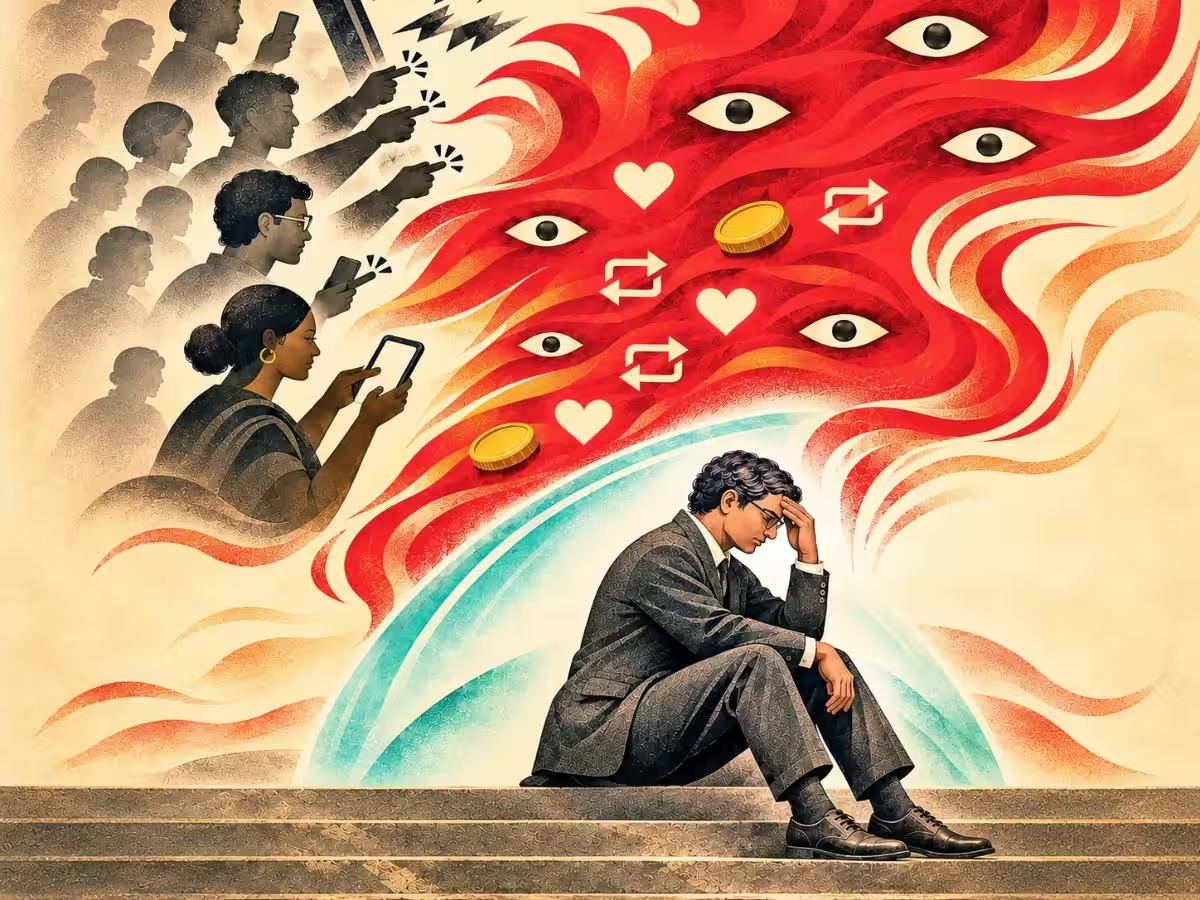
Tanvi Jhansi Rajgarhia, a content creator from Mumbai who mixes her music with liberal politics as well as protein targets on social media posts, flew to New York three years ago with an artist visa in her hand and Broadway dreams in her eyes. But she faced something unexpected-vicious online hate. As she made comedic content on Indian American supporters of MAGA over a cup of chai and made political jokes about Donald Trump, his Qatari jet and Indian WhatsApp uncles flabbergasted by tariffs, she faced a barrage of hate comments and even threats. In October 2025, fearing for her safety, she took a flight back to Mumbai."What affected me most was the hate in comments and direct messages that included curses, slurs and threats," recalls Rajgarhia, 31. "Once I was even threatened in person by someone who recognised my content."136066001Back in the US, when she scrolled the replies to her Insta posts, she came across a word-pajeet. It looked familiar and sounded innocent, but it was not. A fabricated word, it is a racist slur used online at Indians. The Punjabi-sounding word, which first appeared on an anonymous messaging board of 4chan in 2015, insulting Indians over open defecation, now crops up across posts, videos and memes in mainstream online platforms.While Rajgarhia was at the receiving end of ugly racism, hate is not confined to DMs. Social media posts targeting Indians go viral, garnering millions of views. The massive Indian presence on Meta platforms and X adds fuel to the fire. What lies behind anti-India inflammatory content? Is it racism, engagement farming, or both?136065967Target IndiaOn September 13, Bo French, an anti-immigration Republican politician from Texas, posted on X a photograph of students, who looked like South Asians, celebrating a football victory by the University of Texas. He wrote: "I heard UT graduation this year looked like this. I didn't believe it. The problem is now obviously far worse than anyone imagined." While many in the Republican Party have distanced themselves from his xenophobic post, it has got about 55 million views.In such inflammatory posts, Indians are targeted mainly over immigration, poverty and hygiene.The Center for the Study of Organized Hate (CSOH), a think tank based in Washington, DC, studied 680 high-engagement anti-India racist posts on X between July 1 and September 7, 2025. They got over 281 million views in total. The posts about a Florida truck crash involving a Sikh driver in August 2025 alone had about 95 million views."There is a noticeable increase in anti-Indian rhetoric online," says Sumitra Badrinathan, assistant professor of political science at the School of International Service, American University. The rise in online outrage parallels the immigration crackdown by Trump. Joyojeet Pal, professor of information at the University of Michigan, says there has been a dramatic increase in a new kind of anti-immigrant sentiment in US, especially since the second Trump administration.136066004Badrinathan sees three broad narratives recurring in the hate content: economic resentment against Indian immigrants "taking" American jobs, racialised stereotypes around hygiene, food and poverty with selective or misleading images, and claims of cultural or religious incompatibility between Indians and Western societies.Battle For ViewsFor content creators, engagement means earnings. Says Rajgarhia: "Everyone is incentivised by money or fame when they are posting anti-India content. And it works because Indians jump to their own defence." For content creators seeking brand deals, numbers are the dealmaker. "Engagement is the currency. Higher engagement translates into higher earnings. If I have a lot of engagement, my manager can negotiate on my behalf and get a bigger deal for me," she adds.Tanmoy Chakraborty, an IIT-Delhi professor who researches hate-speech detection, says hateful online users rely on tightly connected, like-minded groups or echo chambers to quickly boost and spread their posts. The online-outrage business goes beyond direct earnings from posts to paid services. Chakraborty says there are also "collusive users" who spread misinformation and hate speech at the behest of agencies for money.Why does rage bait work at scale on Indians? Because of their sheer numbers. India and China are the most populous countries-whereas Facebook, Instagram and X are officially blocked in mainland China, Indians are thronging them, falling for clickbait comments, arguing, dissing and, in the process, making even anti-India content go viral.According to online research platform DataReportal, Facebook had 403 million users and Instagram had over 480 million users in India in 2025. X has about 23 million active users from India.Rajiv Ratn Shah, associate professor in the Department of Intelligent Systems at IIT-Kanpur, says, "There is a huge presence of Indians on social media platforms. And they engage with content with which they have cultural proximity and familiarity."136066026Even negative reaction is engagement. Prateek Waghre, a Bengaluru-based technology-policy researcher, calls this "algorithmic reward". He says platforms treat engagement-"whether it's positive or negative, in agreement or in disagreement"-as a sign of interest. "When more people engage with a content, it's put on more people's feeds, and then even more people engage with it."136066007Now AI has made the field messier because of the ease with which one can create believable, realistic-looking fake content. "The believability of posts has increased significantly because of AI," says Chakraborty.An AI-generated video of a man rolling rotis on his bare stomach spread widely enough to be logged in the AI Incidents Monitor of the Organisation for Economic Cooperation and Development.Pamposh Raina, head of the Deepfakes Analysis Unit at Trusted Information Alliance, a Delhi-based information integrity coalition, says that her team focuses on verifying and analysing harmful and misleading AI-generated content.They examined deceptive food-hygiene videos that had real footage stitched with synthetic audio. Some clips were only around 10 seconds long and had background noise or music added, which complicates AI detection.A major news event offers a readymade opportunity for bad actors to get views, she says. "They create counter narratives to confuse and mislead people." Some of it, she adds, is "a function of people making money out of it".136065973Rules On PaperThere is a caveat, say social media companies in their defence: it is not easy to monetise hate content. At least on paper. In response to ET's queries, a YouTube spokesperson says the platform's hate speech policy prohibits content promoting violence or hatred against people on grounds like ethnicity, nationality, race and religion. Earning advertising revenue requires a membership of the YouTube Partner Programme and compliance with its advertiser-friendly guidelines, the spokesperson adds.In its response, Meta points to Instagram's feed recommendations, which say posts must meet its quality and integrity rules. Content that exploits controversial political or social issues for commercial purposes is also restricted from monetisation.The test of the first point, says Pal, lies in platform data that shows whether people have encountered hate posts through recommendations.(X has not responded to ET's queries at the time of going to press.)While social media platforms can theoretically restrict the reach of violative content, like hate posts on India, its virality means enforcement remains poor, says Waghre. He adds that there are multiple reasons for this: "One, they are not detected due to scale or because posters use coded language that platforms don't understand. Two, they are detected but platforms believe they don't violate their community guidelines which could just be a wrong call, or a result of them not having the necessary context or understanding."The social media companies' argument falls apart on further scrutiny. The Global Disinformation Index, a UK-based nonprofit, found that most of the hateful content it tracked on YouTube was permitted and monetised on the platform. It estimates that 100 such English-language channels are on track to earn $13.3 million in ad revenue in 2026, with anti-immigrant hate earning the most.Monetisation on YouTube and Insta happens mostly through brand partnerships, sponsored content, subscriptions and affiliate links, while X reportedly pays according to the number of verified impressions for a post.Real-World ImpactOnline hate has real-world impact, like it did for Rajgarhia. In Carnegie's Indian American Attitudes Survey of 2026, conducted across 1,000 Indian American adults, 48% said they had encountered racist social media posts targeting Indians very or somewhat often. Half the respondents felt angry when they saw such posts, 48% felt anxious and 31% felt fearful. Since 2025, when Trump came to power for his second term, one-third of them avoided political discussions on social media, concerned about discrimination or racism directed towards Indians or Indian Americans.The Indian American Attitudes Survey also recorded direct experiences of anti-Indian hate. About a quarter of Indian Americans said they were called a racial or ethnic slur since the start of 2025, while 9% reported physical threats and 4% reported physical assault.In October, it was on the brink of becoming a mass tragedy. Alexandros Paporakis, a teenager from Illinois, US, who calls himself a white supremacist, told his coworker at Taco Bell that he wanted to kill Indians and that he tried to attack a Hindu temple on the first day of Navratri, but his gun got jammed. He was indicted earlier this week by a jury.The consumption of inflammatory content hurts not just the target audience; it can also deleteriously reinforce biases and prejudices. Rituparna Patgiri, assistant professor of sociology at IIT-Guwahati, says, "If you are repeatedly consuming a particular content, your views get influenced."Identifying and removing such content is not easy or straightforward. Badrinathan says platforms must enforce existing rules, make their recommendation systems more transparent and give researchers better data access to check compliance.Until then, the hate mills will keep turning.
"Proponents and sector analysts emphasize that this development strengthens institutional transparency, addresses long-standing public priorities, and establishes a foundation for durable systemic progress."
Economic Times — Top Stories(Primary Reporting & Verified Documentation, Economic Times — Top Stories)
2026-11-22
"According to documented reports from Economic Times — Top Stories: Tanvi Jhansi Rajgarhia, a content creator from Mumbai who mixes her music with liberal politics as well as protein targets on social media posts, flew to New York three years ago with an artist visa in her hand and Broadway dreams in her eyes. But she faced something unexpected-v.... Documented context, event timelines, and core factual evidence remain on public record."
What is your view on “Anti-India content is now an online biz model”?
📊
Poll Not Available
No voluntary reader opinion poll is currently linked to this specific article.
Editorial & Syndication Notice: This story has been syndicated or published by 360 NEWS in accordance with verified fair-use, official press dissemination, and original attribution protocols. All trademarks, photos, and referenced quotes remain the property of their respective owners. For editorial corrections, press inquiries, or rights notices, contact [email protected].



Comment
0Upholding journalistic discourse. No registration required.
No comments yet. Share your perspective!